Monday, June 27, 2016

Radial Avenues Part I: Jefferson

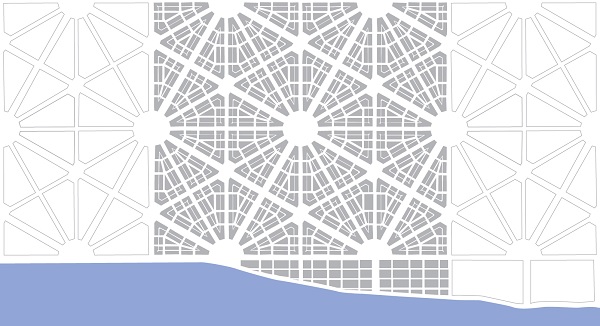
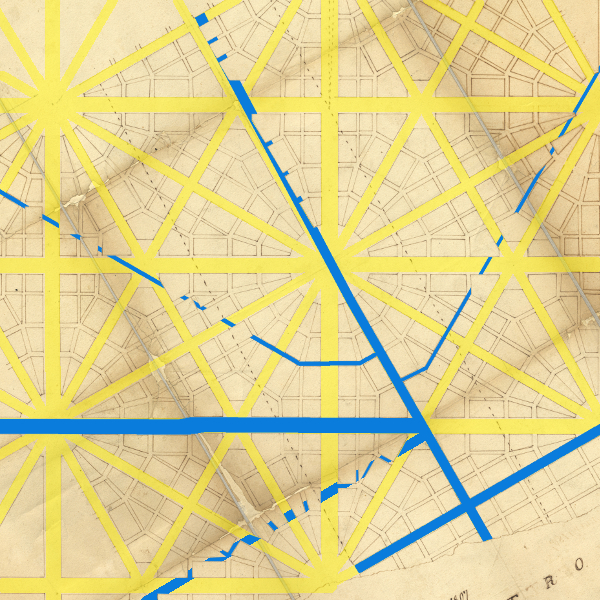
The arrangement of Detroit's main avenues, radiating from the center of the city like the spokes of a wheel, is often attributed to Augustus Woodward's Plan of Detroit, devised between 1805-1807. This is not completely accurate. When you compare today's radial avenues to early renditions of the Woodward Plan, it's clear that the two are not completely in sync.


In fact, the Woodward Plan did not call for five avenues to extend from a central area, but for dozens of avenues to crisscross a busy city.


While some segments of these roads did begin on the Woodward Plan, Detroit's characteristic radial avenues are mostly the result of a military highway system implemented by Governors William Hull and Lewis Cass in the 1810s and 1820s. Today's roads don't so much extend outward from the Woodward Plan as much as they were skillfully woven into it after the city was already surveyed.

This is the first in a series of articles about the early origins of Detroit's radial avenues--when they were laid out, why they exist where they do, and what connections they might have to the Woodward Plan or Native American trails.

* * * * *


Detroit's Main Street


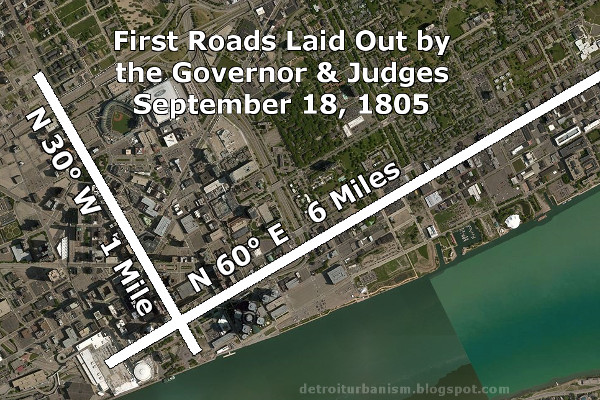
The first pieces of the radial system to be laid out (if only on paper) were one mile of Woodward Avenue and six miles of Jefferson Avenue. There were in fact the very first roads established after the great fire of June 11, 1805. Although the Woodward Plan had not yet been officially enacted, these roads were created by law in section two of "An act concerning highways and roads," passed by the territorial government on September 18, 1805. Neither road immediately had a formal name, but early documents refer to Jefferson Avenue as "Main Street."


Jefferson Avenue was never built six miles straight as defined in the 1805 law. On June 23, 1817, the territorial government passed An Act for Opening and Regulating Roads and Highways, which repealed the original legislation and redefined Jefferson Avenue as extending only one mile east of Woodward Avenue, and west from Woodward until it intersected the river. Six months later, a second act entitled "An Act for Opening and Regulating Roads and Highways" was passed on December 1, 1817, which repealed the June act but did not re-establish Jefferson Avenue. This law was in turn repealed on December 30, 1819 with "An Act to Regulate Highways," which once more defined Jefferson Avenue as extending from the river to one mile east of Woodward Avenue.

On April 26, 1821, the territorial government approved "An act to extend Jefferson-avenue in the city of Detroit," which continued the avenue eastward "until it shall intersect the ancient French road, now traveled from La Grosse Pointe to the city of Detroit." This straight, "radial" portion of Jefferson Avenue remains just under three miles long, from Cobo Hall to just beyond the Douglas MacArthur Bridge at Belle Isle.

It was some time until Jefferson Avenue was built that far. Thomas Palmer recalled that, during his childhood in the 1830s, "Jefferson avenue was the principal street for business and residences. A rail fence terminated it at Russell street, and nothing but farms existed beyond."


Grave Obstruction


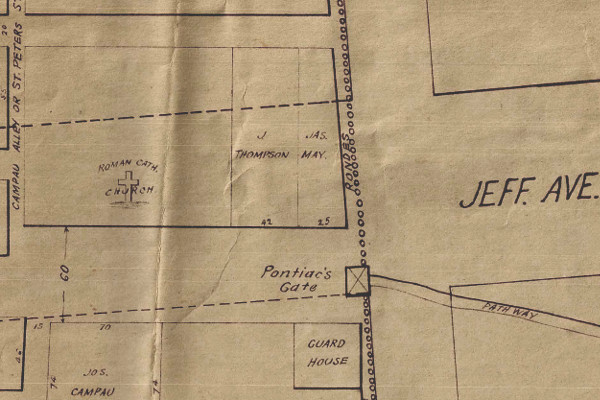
To open Jefferson Avenue, the government needed to obtain private property both from the surrounding farms as well as the old town of Detroit. Although the great fire of 1805 had removed every building (except one) from the road's path, there was a particularly problematic obstacle remaining: the Roman Catholic cemetery. St. Anne's Church burned in the fire, but its burial ground remained intact partially on land that was to become part of the avenue, between what is now Griswold and Shelby Streets.


Detail from Detroit - Prior to the Fire of June 11, 1805, by R. J. Mackey.
Image courtesy Detroit Historical Society.
(Source.)

After a lengthy dispute between government and church officials, the graves were ultimately moved. In 1889, historian Silas Farmer wrote,
There are living witnesses who, as late as 1818, saw graves occupying a portion of what is now Jefferson Avenue ; from time to time since then, as excavations have been made for sewers and cellars in the vicinity, remains have been uncovered.


East Jefferson Avenue


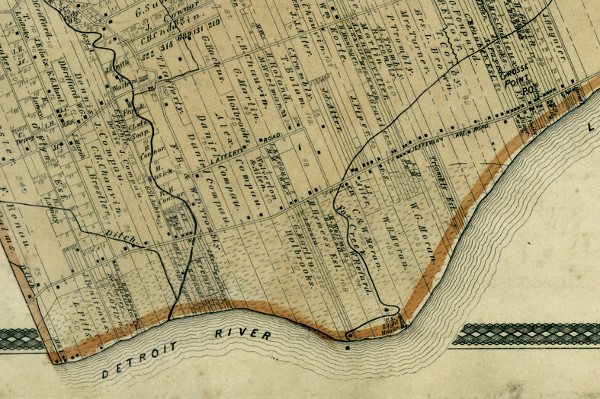
From a point just beyond the bridge to Belle Isle, East Jefferson Avenue joins "the ancient French road" to Grosse Pointe. This original road veered inland away from the river in order to avoid what was once Le Grande Marais (The Great Marsh). The site of the marsh, now dry land, was located close to the present-day border of Detroit and Grosse Pointe Park.


The path of East Jefferson Ave. avoids what was once marshland.
Detail from an 1876 atlas of Wayne County.
(Source.)

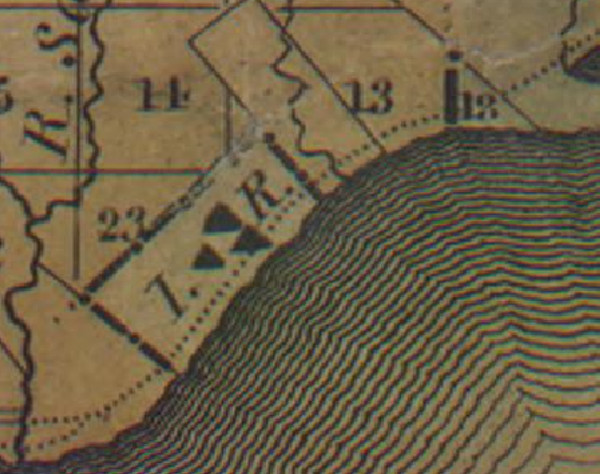
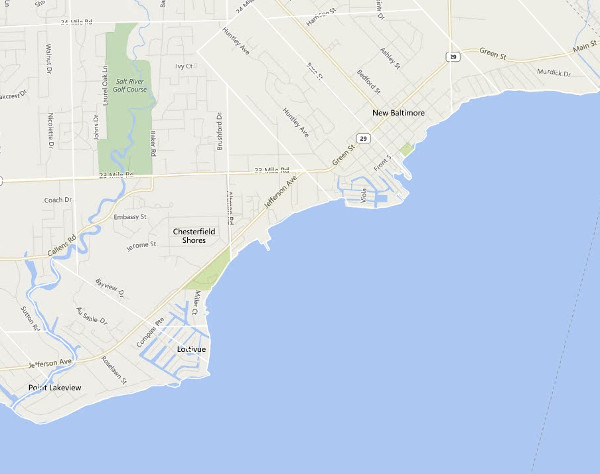
The remainder of East Jefferson Avenue in Metro Detroit more or less follows the ancient footpath that paralleled the shore of Lake St. Clair. Orange Risdon's 1825 map of southeast Michigan shows an Indian trail along the lake shore in what is now Chesterfield Township and the City of New Baltimore. In the detail from the Risdon map below, the area marked by three triangles and the initials "I.R." was a Chippewa reservation between 1807-1836.


Detail from Orange Risdon's 1825 map of the Michigan Territory. (Source.)


East Jefferson Avenue in Chesterfield and New Baltimore today.


Hull's Trace


On the west side of the city was another "ancient French road" that had started as a Native American trail. What was a humble dirt road following the Detroit River to Lake Erie when the Americans Arrived would be transformed into a military highway.

On December 19, 1808, the territorial government passed "An act for laying out and opening a road from the city of Detroit to the foot of the rapids of the Miami, which enters into Lake Erie." This badly needed military supply road was to connect Detroit to what was soon to be the site of Fort Meigs, or what is now Perrysburg, Ohio.

Governor William Hull ordered a route for the new road to be surveyed immediately. An 1809 petition to President James Monroe (suspected to have been written by Augustus Woodward) alleged that Hull "authorised a number of Commissioners to explore a road to the Miami [River], in the dead of winter; when the country was but one sheet of ice and snow; and which it would be impossible for the same, or any other persons to find again in the summer time." The criticism would prove to be valid.


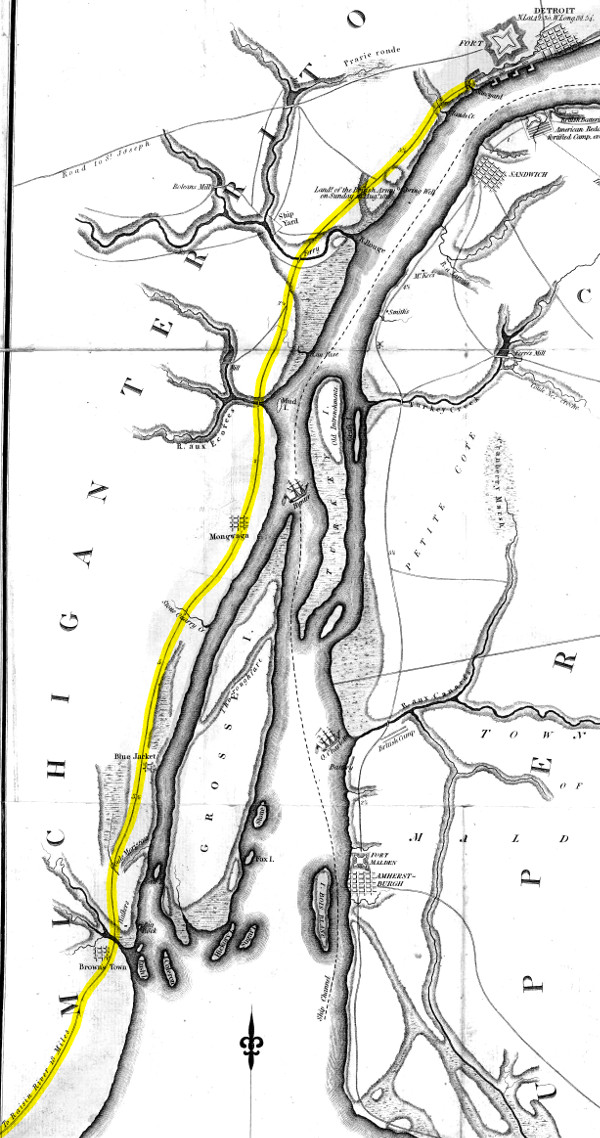
A British map of the Detroit River published in 1813 with Hull's Road highlighted.
Note that the road travels through the Indian villages of Maguaga and Brownstown.
Image courtesy DavidRumsey.com
(Source.)

Construction on the road was delayed until the very eve of the War of 1812. Captain Hubert Lacroix began the work in Monroe, sending part of his force of 150 militiamen north to cut the road toward Detroit, with the remainder working southward. Meanwhile, Governor Hull and a force of 2,300 soldiers quickly hacked their way northward from Ohio. In June of 1812, Lacroix complained, "I have not been able to find the road exactly in the place laid out by the Commissioners, but according to the best information that I have been able to obtain, we are nearly in the same course." According to researcher Daniel Harrison, the road was built over the easy-to-find shoreline Native American trail, rather than the much safer inland route surveyed three years before. Constructing the road in this vulnerable location deprived Fort Detroit of a reliable supply line, which was a major factor in its surrender to the British in August 1812. The Battles of Brownstown and Maguaga were fought on this road days before Detriot's surrender.


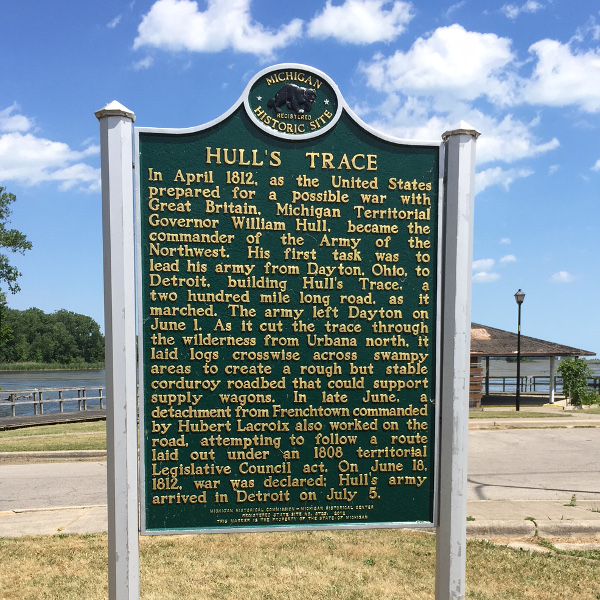
Historical marker in River View Park, Brownstown Township.
Photograph by the author.


Macomb's Military Highway


In May of 1816, the U.S. Secretary of War ordered Major General Alexander Macomb, an experienced engineer, to build a road between Detroit and Fort Meigs. Rather than start from scratch, Macomb essentially widened and reinforced Hull's road. He started in Detroit, reaching Monroe in November of 1816. Two years later, he reported that the road had been completed to within eight miles of Fort Meigs. "The road is truly a magnificent one," he wrote, "being eighty feet wide cleared of all the logs and under brush, every low place causewayed and all the creeks and rivers requiring it bridged in a substantial manner."

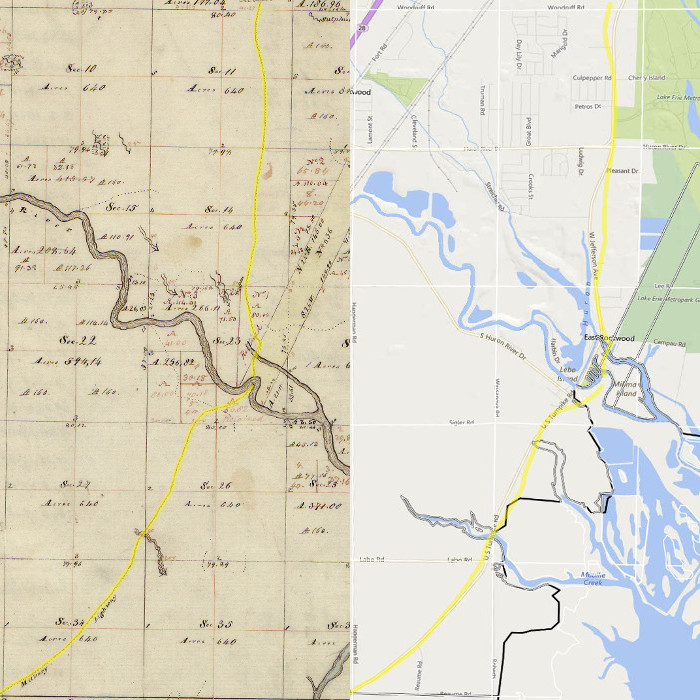
Joseph Fletcher's 1818 survey of what is now the townships of Brownstown and Berlin shows this road where it crosses the Huron River. Today's Jefferson Avenue very closely follows the 200 year old route, with a few alterations.


"A durable road which should remain for ages"


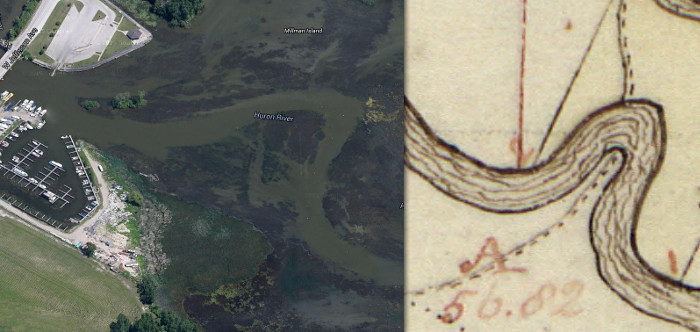
Lake levels were unusually low in 1812. As they rose, the original crossing at the Huron River in Brownstown Township became submerged. This required the relocation of part of the road west of the original path.


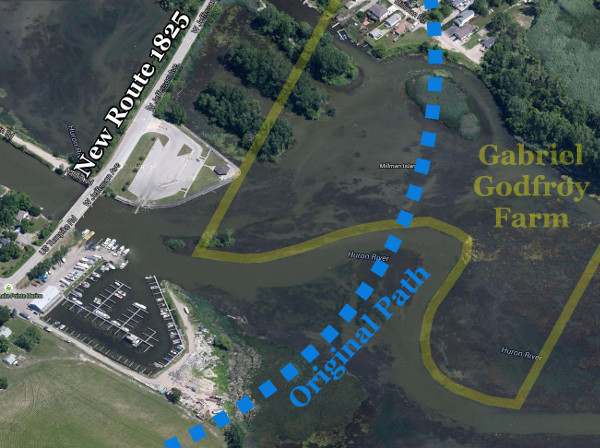
Left: Aerial image of the Jefferson Ave./Huron River crossing today.
Right: Fletcher's 1818 survey showing the original route.

Gabriel Godfroy owned a ribbon farm on the north side of this bend in the Huron River. His tenant, Claude Campau, farmed the land and operated a ferry on this site where the original Native American trail crossed the river. Hull's troops hastily built a bridge on this spot in 1812, which Godfroy replaced with a toll bridge five years later.

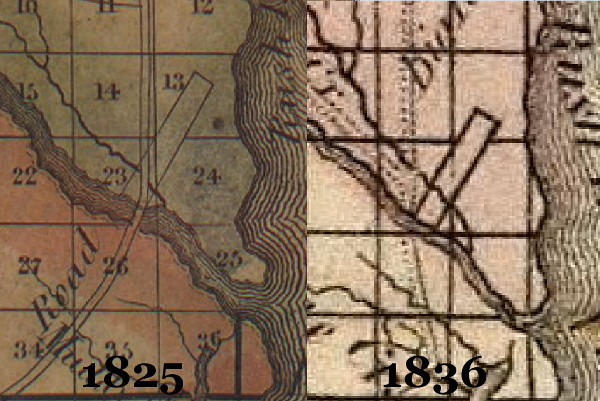
Old maps show the road was rerouted between the 1820s and 1830s. The slanted rectangle in the images below is Godfroy's ribbon farm. Orange Risdon's 1825 map shows the road passing through the base of the farm at Godfroy's toll bridge. But in John Farmer's 1836 map, the road already bypasses this spot.


The road built by Macomb evidently did not satisfactorily hold up to the low, wet conditions of the land south of Detroit. In 1824, Congress appropriated $20,000 for the survey and construction of a road from the Ohio border to Detroit. Secretary of War John C. Calhoun appointed Lewis Cass superintendent the project. While surveying the route, Cass realized that the funds would be insufficient to construct a durable road at its full length of sixty miles. Instead, he chose to lay out a higher quality road where conditions were the most difficult. He wrote,
A permanent road should be made over the worst part of the country... We should possess a durable road, crossing an almost impassable swamp, which, with occasional repairs, would remain for ages. I did not hesitate to make such arrangements, as would give a character of permanence to the work.
Cass designated Otter Creek (four miles south of present-day Monroe) the southern terminus of the project. Private contractors bid for quarter mile portions of the road, and work was well underway by 1825. Congress appropriated $12,000 to continue the road south of Monroe in 1827.

Like Macomb and Hull before him, Cass mostly followed the Native American shoreline trail. The segment that approaches the Huron River was an exception, having been rerouted slightly inland.


The original and new crossings at the Huron River in Brownstown.

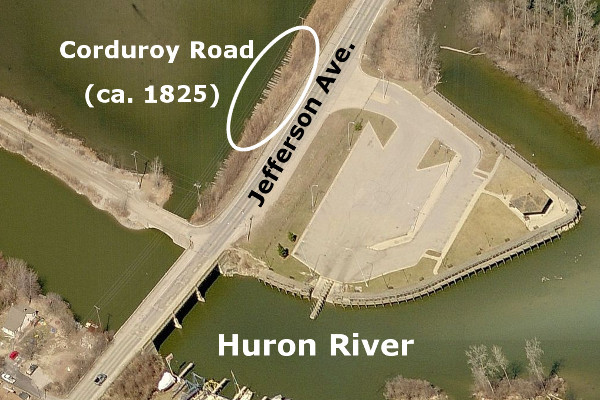
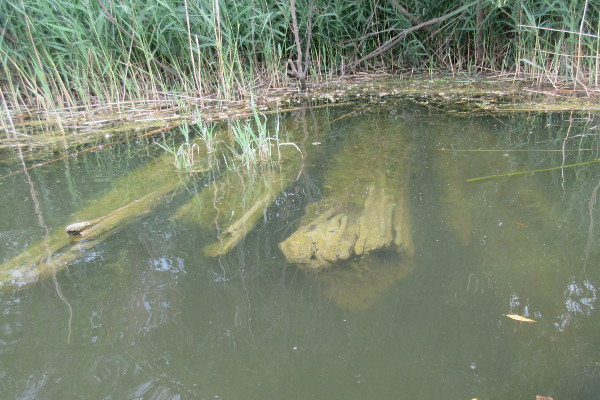
Cass's road, like the original, was a "corduroy road," so called because its base consisted of logs laid across its path. Amazingly, many of these logs were found to be intact beneath Jefferson Avenue (or, more accurately, just alongside it), exposed by low water levels in 2000.


Since 2000, the Huron River has returned to higher levels. Still, parts of the road's foundation--logs felled two centuries ago--remain visible below the surface of the water. More than 500 logs spanning one quarter of a mile have, as Cass intended, survived for ages. Who knows how many miles of centuries-old corduroy roads might remain buried beneath the streets of Metro Detroit?


Remaining fragments of the 1825 corduroy road, now West Jefferson Avenue.
Photograph by the author.


Photograph by the author.


Photograph by the author.


Photograph by the author.

See photos of what the surviving remnants of the corduroy road looked like when water levels were lower here and here.


* * * * *


Check back soon for Radial Avenues Part II: Woodward Avenue!

Monday, June 6, 2016

Woodward Plan Part III: Interruptions

This article is the final installment of a three-part series. Click here to read part one and part two.


Source: Trafficways for 3 Million People, Detroit City Plan Commission, 1954.

Although the Woodward Plan was designed to be an indefinitely repeatable pattern, it never covered more than half of one square mile. Even within this area, it has been infringed and even removed. This article explores why the plan never expanded and how these disruptions came to be.


The Park Lots & Ten Thousand Acre Tract


The 1806 law that allowed the governor and judges to lay out a new town also directed them to sell 10,000 acres of adjacent land owned by the U.S. government in order to fund the construction of a court house and a jail. The first area to be sold was the narrow strip of land north of the town lying between the Brush and Cass farms. It was divided into lots ranging from five to ten acres.

These lots, which came to be known as the Park Lots, were auctioned off in 1809. When deeds were finally issued (some as late as 1816), Judge Woodward added the proviso "the City of Detroit may extend over [the lots], without [the owner] expecting or claiming any compensation for the avenues, streets, roads, alleys, lanes, squares, circuses and other public spaces and reservations of ground of the said City of Detroit according to the original plan thereof." The Woodward Plan wasn't technically defeated, but this proviso hardly guaranteed its northward expansion.

Then in late 1817, the governor and judges resolved to sell the rest of the 10,000 acres, which had been surveyed into farms containing roughly 160 acres each in a large rectangle known as the Ten Thousand Acre Tract. The farms were set to be auctioned on June 1, 1818.


Woodward wrote a long and detailed protest against the sale, knowing that his plan could never extend into parcels completely at odds with it. His arguments included:
  • Federal law specifically authorized the governor and judges to lay out a town. The disposal of the land into large farming tracts was illegal.
  • Territorial law established the Woodward Plan as the basis for Detroit, and dividing land into 160-acre parcels contrary to the plan was a violation of the law.
  • The plan sent to Congress in late 1806 clearly showed Woodward's system extending far north of the Grand Circus, and to deviate from the plan was an "unlawful assumption of power."
Above all, abandoning the plan was especially short sighted in light of the city's imminent growth, which Woodward fully grasped even at this early date:
Nature has destined the city of Detroit to be a great interior emporium, equal, if not superior, to any other on the surface of the terraqueous globe.... In such a case the art of man should aid the benevolence of the Creator, and no restricted attachment to the present day or to present interests, should induce a permanent sacrifice of ulterior and brilliant prospects. ...

None of the great cities of Europe,--Lisbon, Paris, London, Dublin, Moscow,--can boast an antiquity (of more than) eight centuries, to the period when their magnitude, resources and accommodations were inferior to those of the present city of Detroit. If then in that period, of some in less, they have grown to their present opulence, splendor and celebrity, what may not the same period, prospectively regarded, bring about with respect to the city of Detroit, with superior natural advantages to any of these, and under a government more free, and (ten) times more enlightened? In half that period, it is not possible to assert not within one fourth of it, this phoenix of the world, now rising from the ashes of its parents, may transcend the present glories of those great and celebrated marts.
Woodward even offered a compromise: It so happened that it was possible to divide the land into rectangles containing approximately 160 acres in such a way that would conveniently accommodate the Plan of Detroit. Let the farmers farm, Woodward proposed, but on the the condition that they let the streets, avenues, plazas, etc. run through their land when the city reaches them. Woodward even offered to pay the estimated $300 to resurvey the ten thousand acre tract accordingly.


It was not to be. Woodward's protest was ignored, and the sale was held as planned. The Woodward Plan never extended north of the center line of Adams Avenue. In fact, Adams Avenue was never built to its planned width of 120 feet, but remains only sixty feet wide.


The Military Reserve


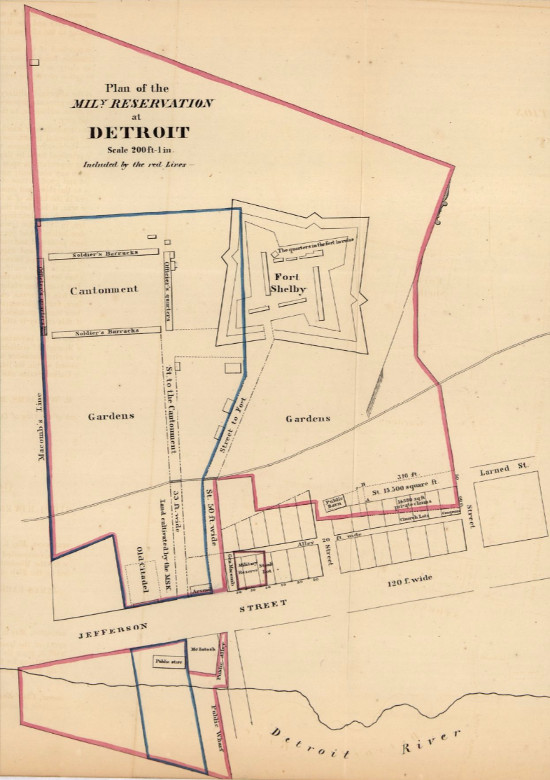
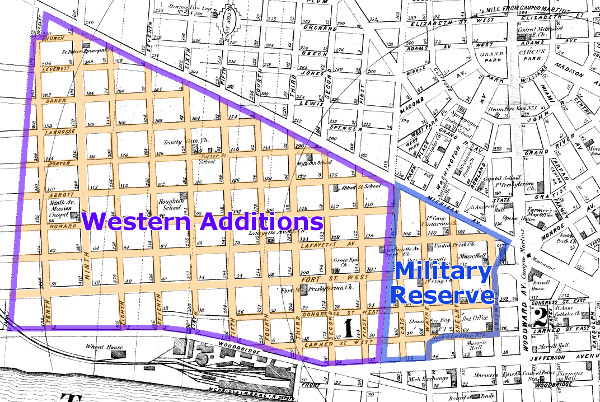
When the territorial government was empowered to lay out a new town in 1806, an exception was made for the land surrounding the fort. This land remained property of the U.S. government until an improved fort could be constructed elsewhere.


The Military Reserve at Detroit.
Image courtesy Library of Congress.
(Source.)

On May 26, 1824, Congress granted a small part of the Military Reserve to the city, including Larned Street and the lots on its south side, between Griswold and Wayne Streets. There were no violations to the Woodward Plan in this area.

The City of Detroit petitioned Congress in January 1826, stating that the large quantity of ammunition stored on the Military Reserve was a "danger to the safety of the city and the lives of its inhabitants." The city asked that the military operations be moved farther away, and inquired whether the city could obtain the vacated land afterward. As a result, President John Q. Adams signed a bill on May 20, 1826 that granted most of the Military Reserve to the City of Detroit.

The city saw this acquisition as an opportunity to abandon the Woodward Plan once and for all. Although the city council was still bound by territorial law to follow the triangular system, on December 16, 1826 it unanimously adopted a resolution to petition the territorial legislature for the power to alter the city plan in any manner it chooses. The legislature complied, passing "An act relative to the City of Detroit" on April 4, 1827. The city was now free to redraw the map at will.

This law didn't simply apply to the Military Reserve--it permitted the city to scrap the entire plan north of Larned Street. The City Council had the power to condemn all property north of Larned Street--including lots that had been privately owned for more than twenty years--and to lay out an entirely new street grid, either paying the owners of the condemned lots or reassigning them a lot on the new plan. "A project was started, to alter the whole plan of the City, so as to establish it uniformly at right Angles," wrote Mayor John R. Williams in 1831. "This project (was) in the origin a wise and acceptable one."

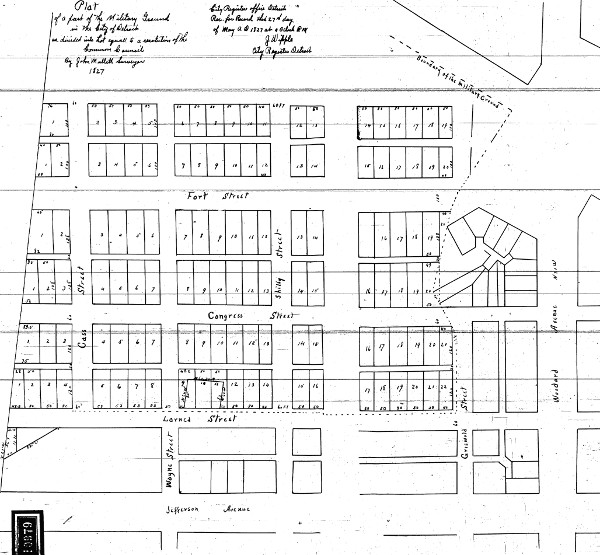
The city wasted no time. An auction of lots on the Military Reserve was advertised just days after the passage of the law, even before a plat was completed. Surveyor John Mullett drew plan of the Military Reserve, divided according to the new gridiron system and submitted it to the Wayne County Register in May of 1827. The auction was held on May 14, 1827 at Military Hall.


John Mullett's plat of the Military Reserve, 1827. (Source.)

The portion between Lafayette and Michigan Avenues was not platted right away, perhaps because the city planned to remove Michigan Avenue, which did not conform to the new grid.

Landowners in the city, alarmed at the city council's actions, petitioned Congress in January 1828, asking them to overturn the territorial law. The petitioners wrote:
[A]n ordinance ... has been passed vacating the recorded plan of the city of Detroit, and authorizing streets and alleys to be run, in directions entirely different, over the private property of your memorialists, throwing everything into the utmost confusion, and thereby impairing and destroying the property and rights of your memorialists without any kind of expediency or necessity for the public good, but merely to gratify the whim and caprice of some men who pretend to have a great predilection to a rectangular plan, instead of the old plan, which is on the basis of an equilateral triangle.
Apparently the issue was solved locally, without federal intervention. Mayor Williams later admitted that "great objections existed" against the new plan, "which became more and more obvious and plain as the subject was examined into." He added, "After much individual effort (and) public Meetings ... the project was upon public reflection abandoned as impracticable."

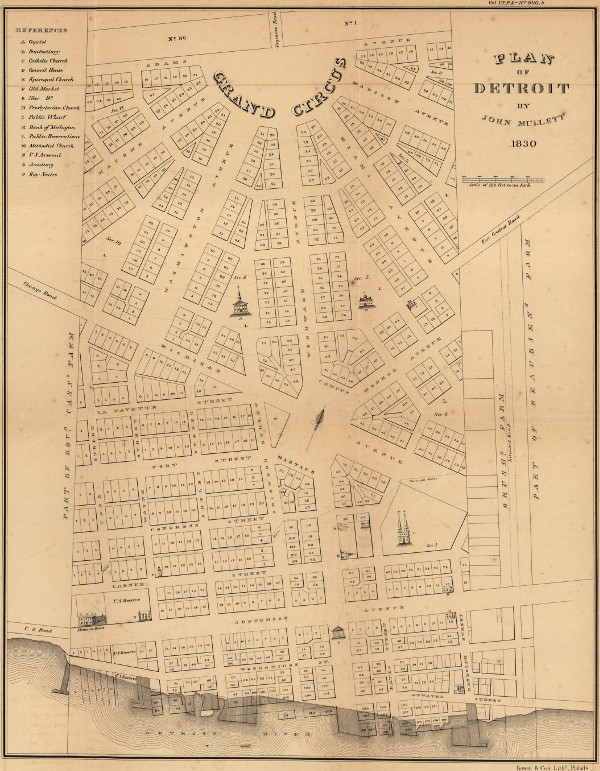
However, the gridiron system remained in place upon the former Military Reserve, a decision which Mayor Williams called "a sort of compromise" between the city and the owners of lots on the Woodward Plan. To this day, the southwest quadrant of downtown is divided into rectangular rather than triangular blocks.


Plan of Detroit by John Mullett, 1830.
Image courtesy Library of Congress.
(Source.)

Aside from the gridiron pattern in and of itself, this scheme also violates the Woodward Plan in that Michigan Avenue, like Adams Avenue, was only built to half of its intended width. Michigan Avenue should have been a continuation of Cadillac Square, a 200-foot-wide "grand avenue." Instead, the thoroughfare has a right-of-way of only 100 feet, and it used to narrow even further to sixty-six feet near Seventh Street.

As the city expanded westward in the 1830s, the Military Reserve gridiron was extended into what is now Corktown, covering all the land south of Michigan Avenue and east of Tenth Street. Parts of this grid have since been removed by the John C. Lodge Expressway and other urban renewal projects.

Although the Woodward Plan had been saved from being wiped out completely, the fact remained that as of 1827, it was no longer the official city plan. Not one more block would be laid out according to Woodward's formula.


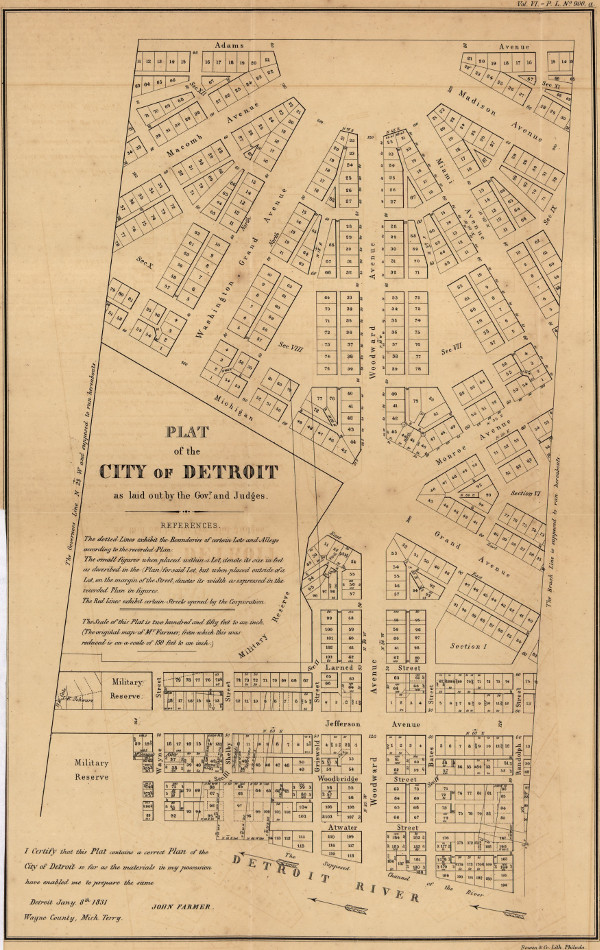
A related violation of the Woodward Plan was the cutting through of Griswold Street across several lots in Sections 2 and 8. This connected the river to the territorial capitol building that was to be built at the center of Section 8.


Plan of Detroit by John Farmer, 1831.
Image courtesy Library of Congress.
(Source.)


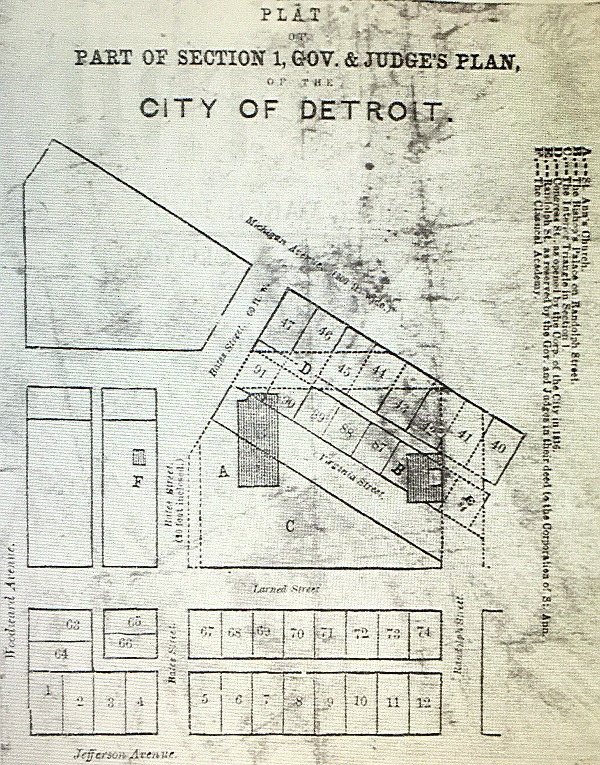
St. Ann's Church


The original Plan of Detroit called for the triangular lot at the center of each section to be reserved for public spaces or buildings, such as parks, schools, and churches. On October 2, 1806 the governor and judges directed that the new Roman Catholic Church was to be built in center of Section 1. No property was conveyed at the time, and construction did not begin on the church for more than a decade.

The Corporation of St. Ann's Church was formally granted the center lot of Section 1, in addition to lots 42-47 and 86-91 in that section, on October 17, 1816. The grant was made on the conditions that lots 40, 41, 84, and 85 remain vacant, as they were being used as an informal connection to Randolph Street; and that the church building be constructed by December 31, 1818, or else the central triangular lot would revert back to public ownership. On May 27, 1818, the governor and judges permitted the church to enclose and build upon the side street that ran on the north side of the center triangle, then called Virginia Street.


Image courtesy Burton Historical Collection, Detroit Public Library.

This violation of the city plan opened the door to more infractions. The church lots that were used as an unofficial road were later officially incorporated into Randolph Street. Congress Street, which used to end at Bates Street, was continued straight through Section 1 in 1836 to conform with the Military Reserve gridiron.

In the late 1940s, two-thirds of Bates Street in Section 1 were eliminated as part of the Civic Center project. Because the sewer beneath Bates Street could not be removed, the City-County Building and an adjacent parking garage were designed to straddle the old right-of-way. The Civic Center project also erased all of the rectangular blocks platted by the governor and judges south of Jefferson Avenue.


Private Claims


The Woodward Plan's greatest impediments of all were the ribbon farms closest to the city. These were owned by Detroit's wealthiest men, one of whom was also the Governor of Michigan. Imagine that the core of the city was only just expanding today, and that the largest tracts of land were owned by Rick Snyder, Manuel Moroun, Mike Ilitch, and Dan Gilbert. How interested do you think they would be in continuing an idealistic city plan that reserved large amounts of land for public ownership? Detroit's major landowners were chiefly interested in dividing their tracts in the quickest, cheapest way possible, maximizing profits and minimizing the amount of land dedicated to public squares and grand avenues.

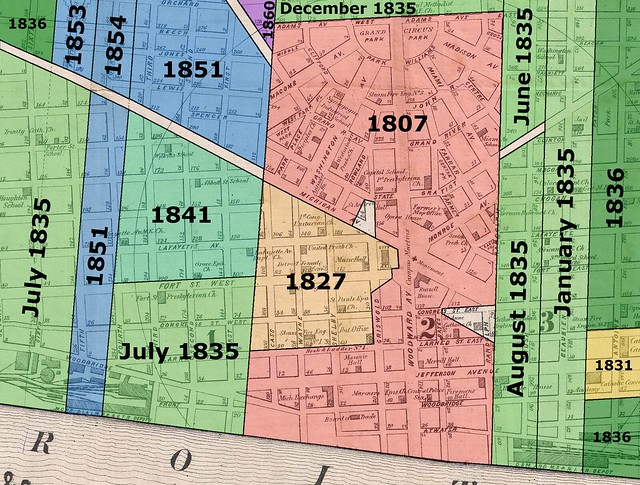
The sale of federally owned land in Michigan led to a boom in the territory's population in the 1830s. It was at this time that farms close to Detroit began to be subdivided. The first subdivisional plat of private land to be submitted to the Wayne County Register was that of portion of the Antoine Beaubien Farm in 1831. The plat anticipated the continuation of Larned Street, Jefferson Avenue, and Woodbridge Street. This plan called for a street to be run north through the farm, called St. Antoine Street.


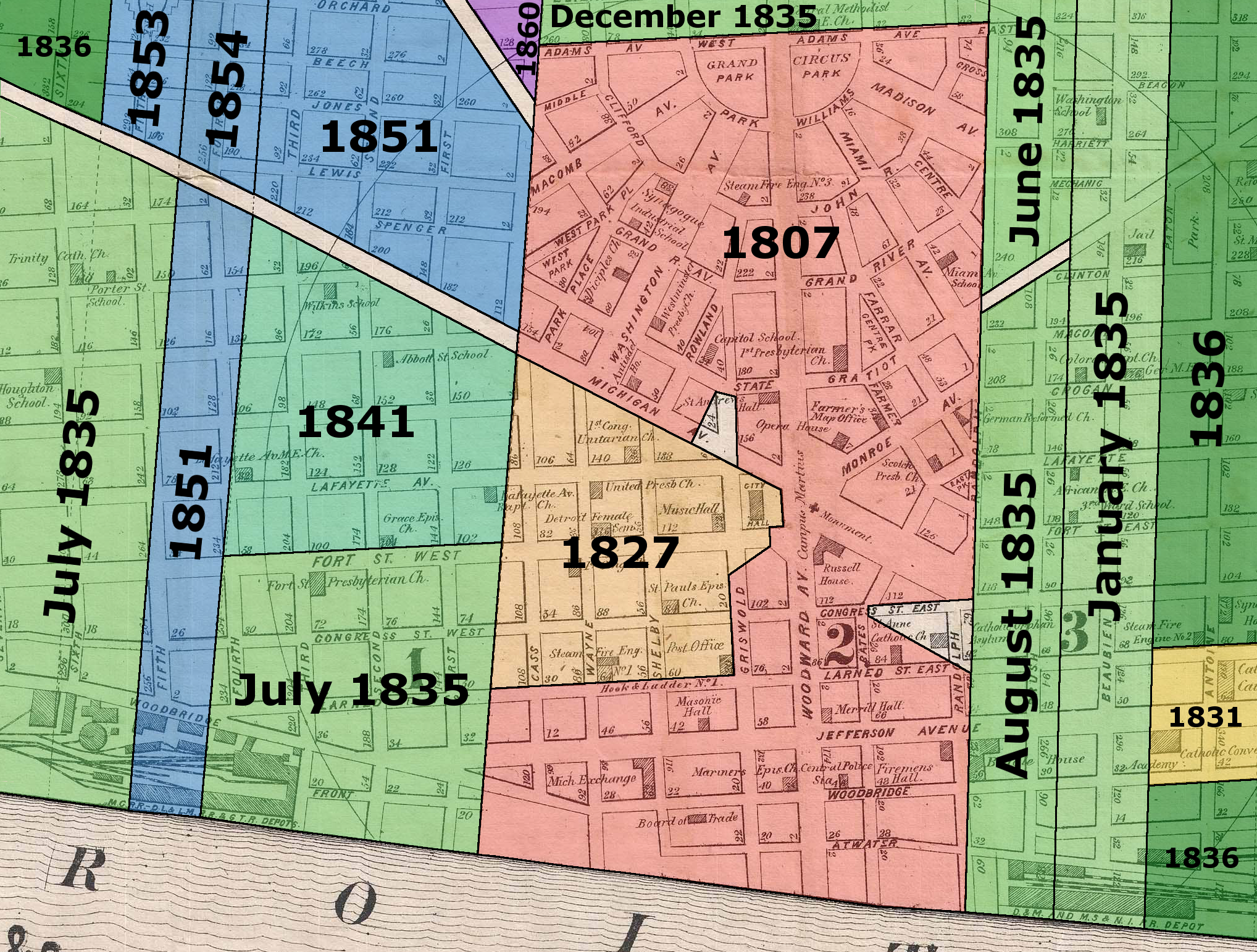
The years in which subdivisions in the heart of Detroit gained legal recognition.
CLICK HERE FOR A LARGER VERSION OF THIS IMAGE.

It's fair to say that 1835 was the year the Woodward Plan was cut off forever. It was then that a multitude of new subdivisions close to the center of the city were recorded by the county. First was the Lambert Beaubien farm, through which Beaubien Street now runs. Although drawn up in 1831, it was not received by the county register until January 1835. This plan made some attempt at cohesion, continuing streets from the Military Reserve (Lafayette, Fort and Congress) as if they were not "interrupted" by the Woodward Plan. This plat was followed by subdivisions of the Brush, Cass, Forsyth and Labrosse farms, as well as the southernmost parcels of the Park Lots, all before the year was out.

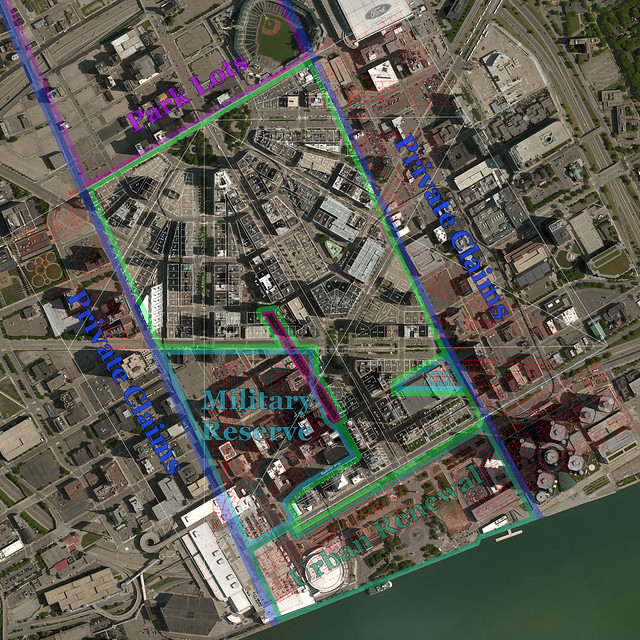
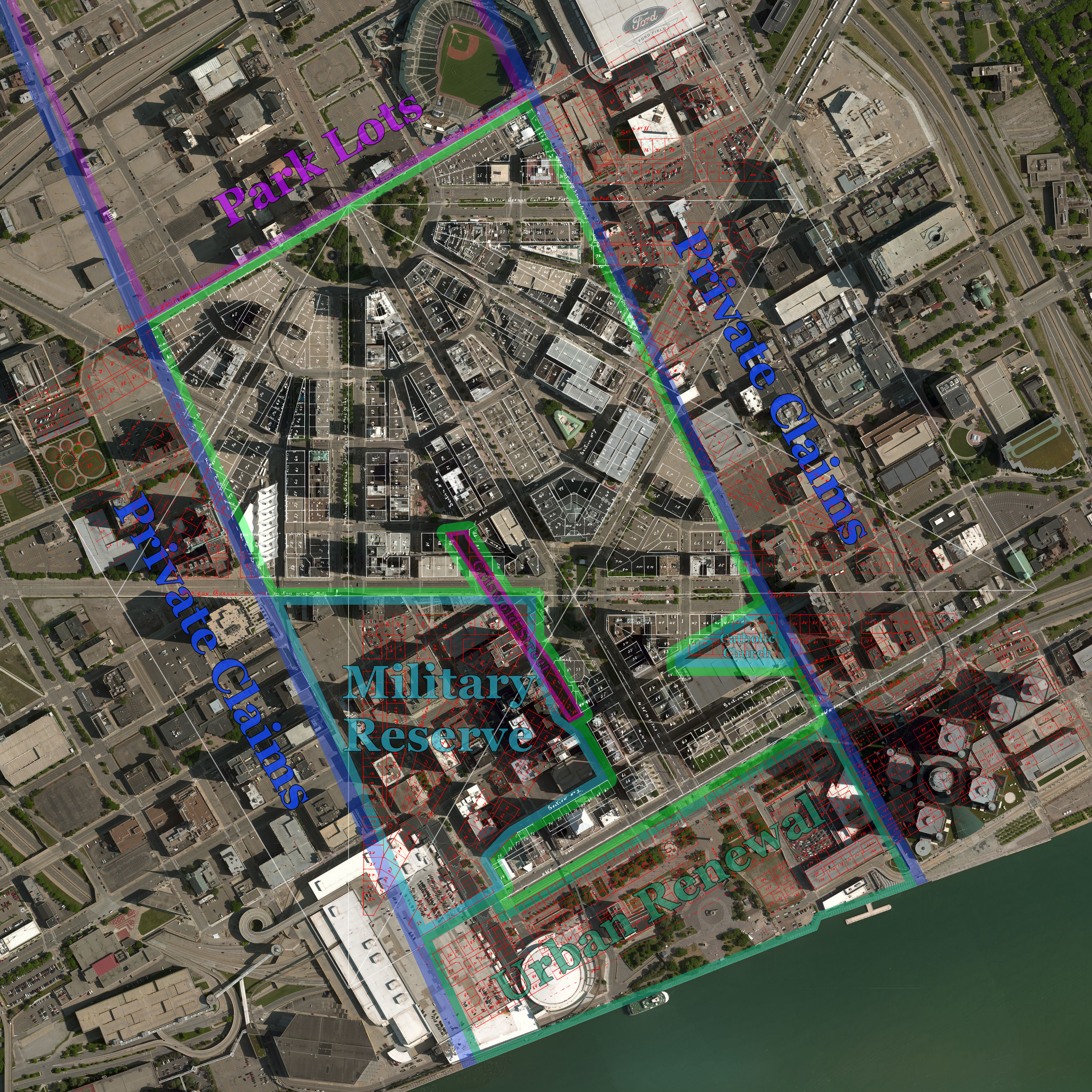
The image below is a satellite photo of downtown Detroit with Abijah Hull's 1807 plat of the Woodward Plan superimposed. Lots that remain more or less intact are outlined in white. Lots that have been removed or that have never been implemented at all are drawn in red. Please click here to explore the full-resolution version of this image. (The file is 6MB and takes a moment to load.)


CLICK HERE FOR A LARGER VERSION.


Miami Avenue


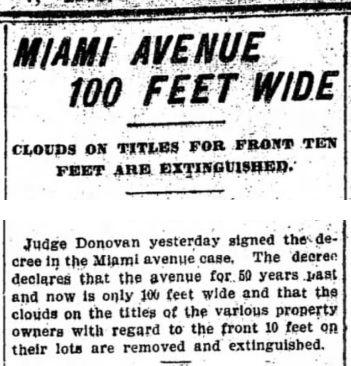
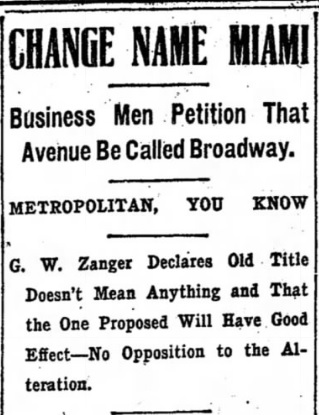
One last violation of the Woodward Plan is worth mentioning. Miami Avenue, according to the plan, should have had a full right-of-way of 120 feet. In the 1840s, when it was yet a residential area, parts of either side of the avenue were fenced in by various homeowners, narrowing the public right-of-way to 100 feet. The issue grew increasingly contentious as commercialization crept in. The builders of stores and hotels required a clearly defined building line.

Years of legal battles finally came to a decisive end when the proprietors on Miami Avenue filed a bill in chancery court in July 1900, arguing that the thoroughfare should be defined as 100 feet wide and that ten feet of the public property in front of each parcel be given to that lot's owner. The judge ultimately ruled in favor of the owners in May 1901.


Source: Detroit Free Press, May 7, 1901.

Five years later, business owners along the narrowed avenue wanted to give the thoroughfare a new name. What name did they choose? Why, Broadway of course!


Source: Detroit Free Press, June 30, 1906.


* * * * *


Consequences


By 1900, Detroit's population grew to one hundred times what it was in 1830. Without a proper street plan, the city had grown so disorganized that the Detroit Board of Commerce hired Frederick Law Olmstead Jr. and Charles Mulford Robinson in 1905 to suggest changes to the city street system. Robinson, an early leader in the discipline of urban planning and author of The Improvement of Towns and Cities, had this to say:
Nearly all the most serious mistakes of Detroit's past have arisen from a disregard of the spirit of the Governor and Judges' plan. If the plotters of the farms had had respect for that, instead of each going his own way, the streets beyond Cass and Brush would not have had the jogs they now have, and Detroit would have had a better chance for beauty and harmony, to say nothing of the added convenience and economy for its citizens in getting about.
In 1915, the Detroit City Plan Commission brought in Chicago city planner Edward H. Bennett to advise on the future course for the city. The final report lamented,
It is most unfortunate that we have not developed the city entirely according to the Woodward plan. It is more than unfortunate that as the city extended itself, the same ideas and the same street lines could not be maintained; and that small parks have not been provided in the section north of Adams avenue. If this had been done, Detroit would have been a very much more handsome and convenient city.
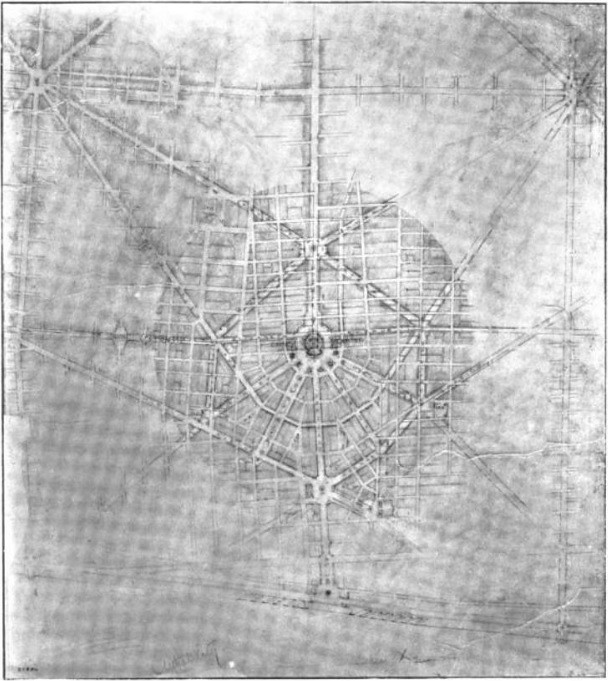
Bennett's suggestions for Detroit included the addition of parks, plazas, and diagonal avenues, as well as the completion of Grand Circus Park--elements that the Woodward Plan took for granted.

One of Bennett's suggestions for the Plan of Detroit. (Source.)

The absence of adequate crosstown thoroughfares and lack of public plazas weren't the only problems that resulted from the abandonment of the Woodward Plan. Avenues that should have been 120 or 200 feet wide were built to as little as 66 feet wide just outside the core of the city. In order to relieve severe traffic congestion, an array of street widening projects became necessary.

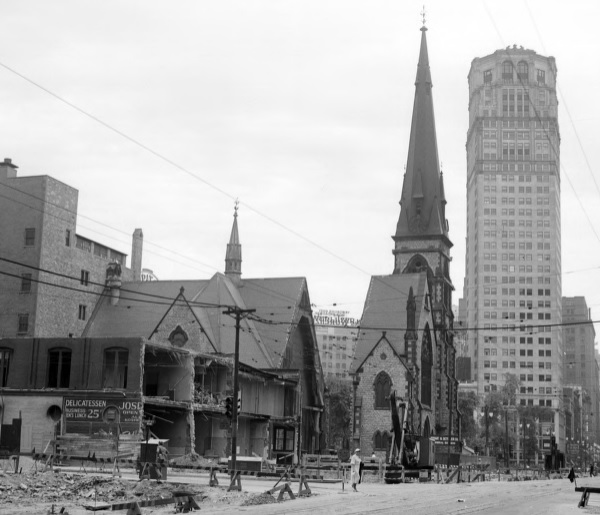
In 1925, Detroiters voted to expand Woodward Avenue to 120 feet wide, from Adams Avenue up to Highland Park. The city council approved the project in 1927, but the condemnation trial did not begin for another two years. A mistrial was declared after the death of a juror, and a final verdict did not come until 1932. Just the first portion of Woodward to be widened--between Kirby and Baltimore Streets--did not open until 1934, nine years and $2.5 million dollars ($44 million in today's money) after the process began. All of this just to bring Woodward Avenue up to the width it was originally prescribed more than 120 years before!

In a 1985 interview with researcher Perry Norton for a paper on the Woodward Plan, Walter Blucher, former CEO of the Detroit City Plan Commission, said that this widening project entailed "cutting chunks off the front of five or six churches, and for that I was consigned to hell at least once a week." In order to save Central United Methodist Church, the easternmost portion was demolished, a section was torn out of its center, and the remaining facade was rolled back thirty feet.


Image courtesy Wayne State University. (Source.)

Similar projects on Detroit's other main thoroughfares were no less of a waste. The widening of Michigan Avenue, for example, permanently mutilated Corktown's main thoroughfare. Had the Woodward Plan been followed from the beginning, there would have been no need to squander precious time and resources on condemnation proceedings, demolition, and rebuilding. So much more our historical architecture might have been saved.

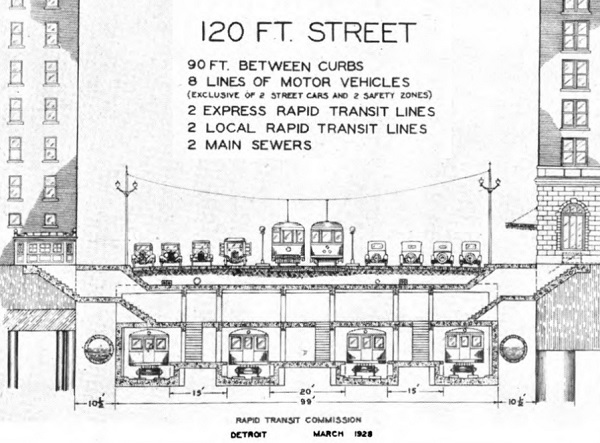
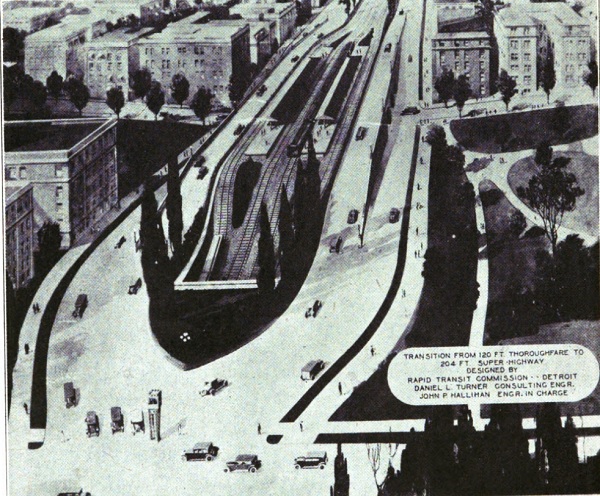
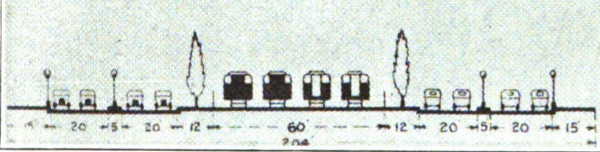
In 1924, city engineers devised a rapid transit plan for Detroit and standardized the rights-of-way that such a system would require. They called for highways 120 feet wide and superhighways 204 feet wide. One hundred twenty feet can accommodate pedestrian traffic, street trees, automobile traffic, street cars, a complete subway system, and other infrastructure. Superhighways would have contained all of these modes of transit, but with trains running at the surface level between opposing lanes of automobile traffic.


(Source.)


(Source.)


A breakdown of the 204-foot right-of-way. This system could easily
fit into Woodward's 200-foot grand avenues with minor alterations.

Many roads in Detroit were widened to 120 and 204 feet wide in anticipation of this modern rapid transit system. But by the time the lengthy condemnation proceedings ended, and hundreds of millions of dollars were spent on condemnation awards, demolition, and repaving, the Great Depression had arrived. When Detroit's economy finally recovered in the 1940s, there was insufficient political will to continue the project. Had Detroit's avenues and grand avenues been built according to Judge Woodward's specifications, all of the time and money spent on acquiring land could have instead been used to begin constructing the rapid transit system itself.


Woodward's Final Years


In 1824, the Territory of Michigan was to cease operating under the "governor and judges" system, and instead adopt a government with separate executive, legislative, and judicial branches. President James Monroe was to appoint the members of the new Supreme Court of Michigan. Jealous lawyers jockeying for positions on the court publicly attacked Woodward, making him a scapegoat for practically every problem that had occurred in the territory since 1805. Some even falsely accused Woodward of holding court in a drunken state. Monroe removed Woodward's name from the list of nominees in light of this accusation. By the time the president learned the truth, the appointments had already been confirmed by the Senate. Woodward's final term expired February 1, 1824, and he returned to Washington a month later.

After Gabriel Richard, Lewis Cass, and other prominent Detroiters came to Woodward's defense, Monroe offered Woodward a Federal district court position in the Territory of Florida. The vindicated judge arrived in Tallahassee in October 1824.

In Florida, Woodward was well-liked and he served capably, but his new career did not last long. After occupying the bench just two years, he died on June 12, 1827, at the age of fifty-two. The cause of death remains unknown. According to biographer Frank B. Woodford, author of Mr. Jefferson's Disciple: A Life of Justice Woodward, "He was buried June 13, from the residence of George Fisher, with the rites of the Masonic order. If his grave was marked, its location has long since been forgotten." Claude Kenneson of the Tallahassee Historical Society told me that this could mean that a ceremony was held in Fisher's home in Tallahassee and that Woodward was buried in whatever cemetery might have been available in the young city; or that Woodward was buried on a plantation owned by Fisher. Fisher did purchase 160 acres about ten miles northeast of Tallahassee the year before Woodward died, and it was commonplace for plantations to have their own small family cemeteries. Whatever the case may be, Woodward's final resting place will likely remain a mystery forever.

During his lifetime, Augustus Woodward's ideas regarding urban planning and Detroit's future were sometimes met with puzzlement and even outright ridicule. He predicted that the modest town of Detroit would grow into a great metropolis; he understood the importance of enlightened city planning in the nascent United States, and how narrow the window of opportunity to act was; and he somehow knew just the right proportions of broad avenues, narrow streets, and public spaces for creating a beautiful and successful city. If urban planners a century ago such as Charles Mulford Robinson and Edward H. Bennett recognized the legitimacy Woodward's ideas then, the judge should be all the more vindicated today, in the age when the failed experiment of mid-twentieth century style tract housing is coming to an end, and when downtown Detroit is experiencing a great resurgence.

When Woodward left Detroit in 1824, a number of friends and associates held a going away party for their beloved judge. It seems appropriate to close here with the words delivered that day by Detroiter John McDonnell:
Be assured, sir, that when the little bickerings and prejudices of the transient hour are buried in the vale of oblivion, when the pulse of the caluminator shall have ceased to beat, when his organ of detraction will no longer furnish a banquet to the worm; and when himself and his character are sunk in forgetfulness, a generation, yet unborn, will do justice to the man in whom were united the philosopher, the patriot, the judge and the philanthropist. In that day, the cultivation of the sciences will add an additional ray to the light which will shine around your name, and a grateful posterity will venerate the memory of him whose labors have enlarged the boundaries of their knowledge.

Monday, April 25, 2016

Woodward Plan Part II: Dawn of the Radial City

This article is the second of a three-part series. Click here to read part one.

* * * * *


"The Woodward Plan" by Kati Belz.

"An Adjustment of Titles"


Governor William Hull and Justice Augustus Woodward left Detroit for Washington in October 1805, seeking approval from Congress for their plan to lay out a new town. They issued a report on the situation in Detroit to President Thomas Jefferson, who delivered it to Congress himself on December 23. Hull and Woodward evidently showed Jefferson the new plan of Detroit, actualized by surveyor Thomas Smith. According to Smith, the plan met Jefferson's personal approval.

Thanks to Woodward's lobbying, Congress passed "An act to provide for the adjustment of titles of land in the town of Detroit and Territory of Michigan, and for other purposes" on April 21, 1806. This law authorized the territorial government to:
  • Establish a new plan for Detroit, including not just the incorporated town, but also 10,000 acres of adjacent federal land.
  • Grant up to 5,000 square feet of property on the new plan to every U.S. citizen over the age of seventeen who lived in the Town of Detroit on the day of the fire.
  • Sell the remainder of the land to fund the construction of a courthouse and jail.
Exempted from territorial control was the fort and surrounding area, known as the Military Reserve. Its boundaries were yet to be finalized.

Hull returned to Detroit June 7, 1806, followed by Woodward and John Griffin, a new judge appointed by Jefferson to fill a vacancy on the court. Justice Frederick Bates had remained in Detroit. The reassembled governor and judges were ready enact legislation under the new powers granted to them by Congress.


"The Bases of the Town"


On September 13, 1806 the governor and judges passed "An Act concerning the town of Detroit," which codified the Woodward Plan, more formally known as the Governor and Judges Plan:
The bases of the town of Detroit shall be an equilateral triangle, having each side of the length of four thousand feet, and having every angle bisected by a perpendicular line upon the opposite side...
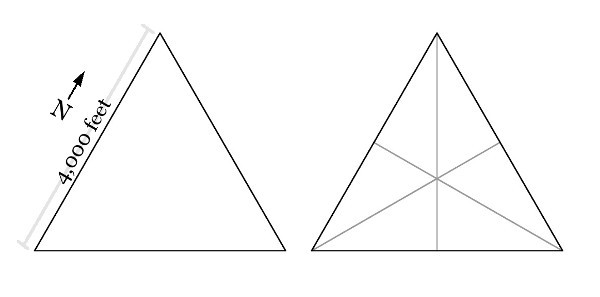

As the settlement grew beyond the confines of the first 4,000-foot triangle, all that town planners had to do was simply add more triangles. This was the main point of the plan--it wasn't simply a decorative arrangement of streets, but a system designed to accommodate growth indefinitely and in an orderly fashion.


Exempted from this pattern were areas close to the Detroit River or where "other unavoidable circumstances may require partial deviation," according to the law. Due to this exemption, the area south of present-day Jefferson Avenue was divided into ordinary rectangular blocks.

The six segments into which each 4,000-foot triangle was divided were simply called "sections." This legislation defined the boundaries of Section 1, beginning at the intersection of Woodward and Jefferson Avenues:
The town shall commence at a stake, distant eighty-four feet ten inches and one fourth of an inch, from the most northern and western corner of the house of Charles Curry, and shall run thence on the course north, sixty degrees east, two thousand feet; thence on a course due west two thousand three hundred nine feet, thence on the course south, thirty degrees east, one thousand one hundred fifty-four feet and six inches, to the beginning ; with such public squares, or spaces of ground, and such avenues, streets, and lanes, as may from time to time be directed by competent authority. The said figure shall be denominated a section, and shall be numbered section one...
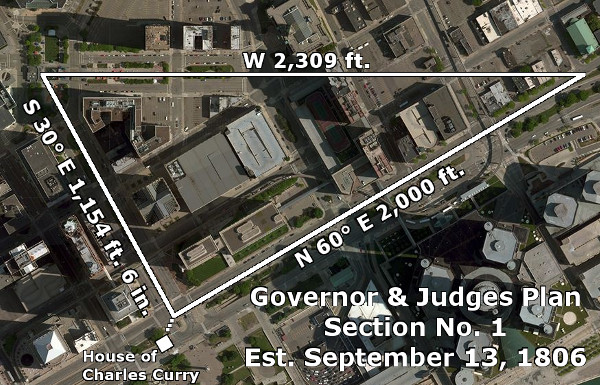
There was nothing special about the house of Charles Curry other than it happened to be the first building standing at the corner of Woodward and Jefferson Avenues. Also, the governor and judges' calculations for Section 1 are slightly off. The approximate lengths of the sides should be, counterclockwise from the bottom: 2,000 feet; 2,309 feet, 4.81 inches; and 1,154 feet, 8.41 inches.

More sections were added, each receiving its number by the order in which they were surveyed. The known numbered sections are as follows:
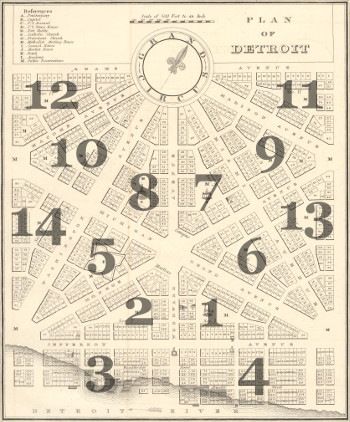

On the same day that the law codifying the Woodward Plan was enacted, the governor and judges passed "An Act concerning the city of Detroit," which stated that the land "laid off, surveyed and numbered" under the preceding law "shall be a city." The Town of Detroit was now the City of Detroit. (Detroit's status would waver between town and city a few more times until its final incorporation in 1824.)


Anatomy of a Section


There is no one "true" version of the Woodward Plan. In fact, disparity among the work of several surveyors (often a result of Woodward's own meddling) created a significant amount of confusion that took years to resolve. Yet some principles have remained constant. Woodward described his plan as having been laid out
with squares, circuses, and other open spaces of ground where six avenues, and where twelve avenues intersect; with all the six sections comprising the triangle uniformly and regularly divided into lots of about five thousand square feet; with an alley or lane coming to the rear of every lot; with subordinate streets of about sixty feet width; with a fine internal space of ground for education and other purposes, with...avenues of one hundred and twenty feet width..."
The broad thoroughfare running along the border of each section was called an avenue. Where twelve avenues came together, a large circular plaza was created (e.g. Grand Circus Park). Six avenues coming together created a smaller rectangular plaza (e.g. Campus Martius). These open spaces were made by clipping off the acute angles of each section, preventing a multitude of narrow and undevelopable lots. There was also a triangular public space reserved at the center of each section. Legislation passed in 1807 directed that this area should be reserved for open spaces or public institutions, such as markets, churches, schools, fire stations, and other government buildings. This law also mandated ten-foot sidewalks and set strict, detailed standards for the planting of street trees--city planning concepts that would meet the approval of New Urbanists of the twenty-first-century.

What follows is a breakdown of how a "section" in the Woodward Plan, once outlined, was generally subdivided. Some details differed between the several versions of the plan, such as the widths of the lots and the exact placements of side streets.
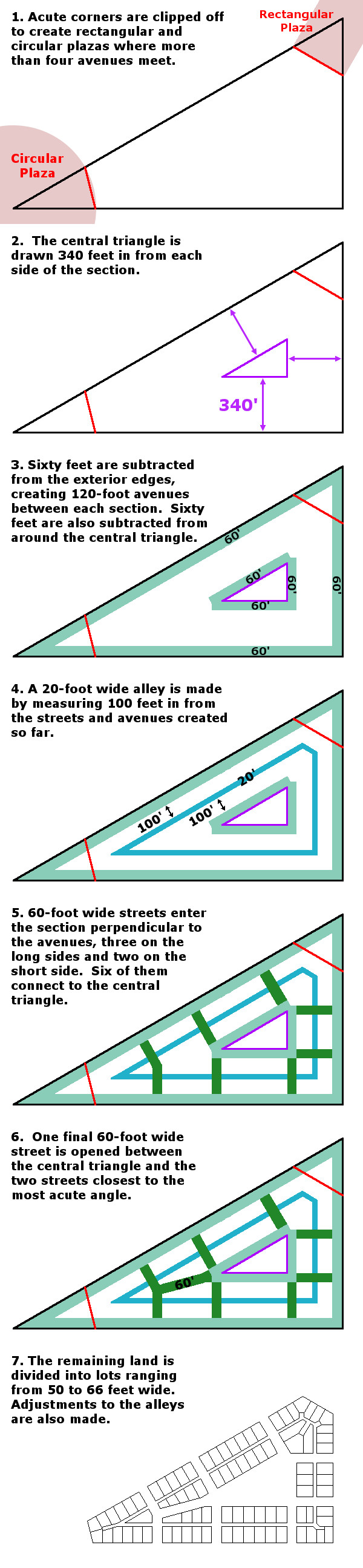

The sections closest to the river were mostly subdivided into lots measuring fifty feet wide by 100 feet deep, because 5,000 square feet was the maximum allowance to be granted according to the 1806 act of Congress. Farther away from the river, the standard rectangular lot was about sixty feet wide, but would vary greatly in width in order to maintain regularity in the street network. Odd widths of 61 feet, 65.65 feet, 62.046 feet, etc. can be seen.


Place Names


The governor and judges originally envisioned the court house for the Supreme Court of Michigan located at the center of the grand circular plaza now referred to as Grand Circus Park. Such a mandate was included in the 1806 law codifying the Woodward Plan, and early documents refer to this area as the Court House Circus. The road leading from the river to the Court House Circus was called Court House Avenue. This road was of course renamed Woodward Avenue, probably around the time an 1815 law repealed the directive to locate a court house in the Grand Circus.

The rectangular plaza where the Point of Origin was set was called the Military Square because it was adjacent to the Military Reserve. The square was renamed Campus Martius, perhaps in imitation of Marietta, Ohio (once the capital of the Northwest Territory) or of ancient Rome, both of which had public squares with the same name.

In some early records, Michigan Avenue was originally referred to as West Street because it ran west out of Campus Martius. Cadillac Square used to be East Street. The center of commercial activity was Main Street, later renamed for Woodward's idol, Thomas Jefferson.


Abijah Hull


The governor and judges created the office of Surveyor of Michigan by a law passed on September 14, 1806. One of the chief duties of this official was to "lay out, survey, mete and bound the Town of Detroit...and all lands, lots, sections, avenues, streets, lanes, squares, and public spaces of ground within the same."

One month later, the governor and judges selected Abijah Hull, a cousin of Governor William Hull, to fill the position. This was much to the chagrin of Stanley Griswold and James Abbott, commissioners of the Detroit Land Office who had favored Aaron Greeley for the job. Griswold, Abbott, and Greeley--together with John Gentle, the British Detroiter who publicly mocked Woodward's Plan--comprised a faction against Governor Hull and his allies. Surveyor James McCloskey claimed that these men were "Constant associates ... frequently seen ... walking the Streets of Detroit together by night." Griswold was Secretary of the Territory, a position he hated, and he conspired to overthrow Governor Hull and take his place.

Within several weeks of his appointment, Abijah Hull completed a new draft of the Woodward Plan. The governor and judges sent it to Congress with a letter dated December 12, 1806, stating, "We have the honor to report ... that we have laid out a town or city, of which a plan accompanies this report, and have made progress in the adjustment of titles and the distribution of the donations ... and expect shortly to complete the same." Hull's drawing is the oldest surviving rendition of the Plan of Detroit.
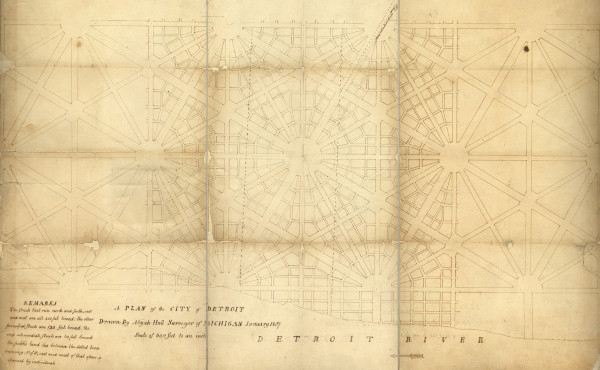

Abijah Hall, "A Plan of the City of Detroit," (1807).
Image courtesy Burton Historical Collection, Detroit Public Library.
(Source.)
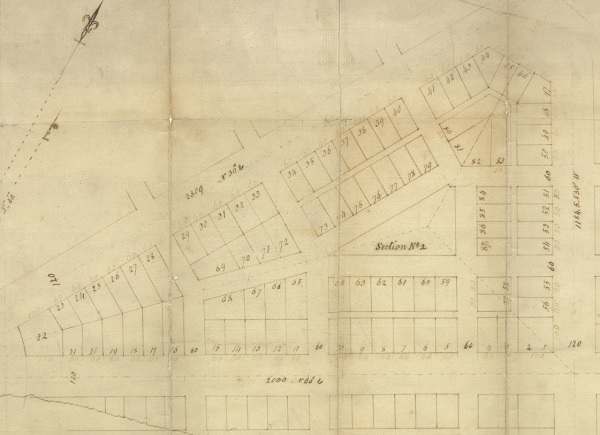

Section No. 2 of the Governor & Judges Plan of Detroit, early version.
Abijah Hall, "A Plan of One Section of Detroit," (1807).
Image courtesy Burton Historical Collection, Detroit Public Library.
(Source.)

Notice that the lots on the left hand side of the lower image do not have rear alleys. This is the only known version of the plan with this omission. The circular plaza at the bottom left is also smaller than subsequent versions, having a radius of only 400 feet rather than 500 feet.

The most significant aspect of Abijah Hull's plan is the variation in the widths of avenues. Apparently, in Thomas Smith's version, all avenues were a uniform 120 feet wide. But by this point, Woodward had instructed Abijah Hull to broaden the avenues that ran north-south or east-west to an extremely generous width of 200 feet. These were referred to as "grand avenues." Smith objected to this change, saying, "The Plan is practicable but it will not admit Innovation without destroying its mathematical beauty and symmetry, and therefore, I was always adverse to the 200 foot streets."

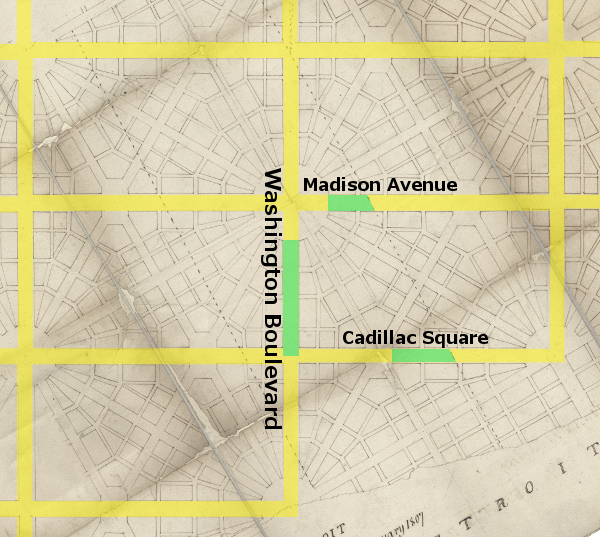
Perhaps Smith never fully appreciated Woodward's grand design, which is easier to see when Abijah Hull's diagram is oriented to true north and the 200-foot grand avenues are highlighted. This creates a grid of rectangular areas each containing 159.05 acres--almost exactly one quarter of a square mile. Had Woodward's plan been fully carried out, this grid would have grounded an otherwise intimidating web of diagonal thoroughfares within a recognizable and familiar framework. Only a few small segments of Woodward's grand avenues were ever built: Washington Boulevard, Madison Avenue, and Cadillac Square. Michigan Avenue runs due west from Campus Martius, but it is only the north half of a grand avenue.

Abijah Hull and Woodward continued to tinker with the plan, eventually producing plats of the first twelve sections of the city, approved by the governor and judges between April 7-27, 1807. In this incarnation, every lot has alley access. Section 2 of this version is below.
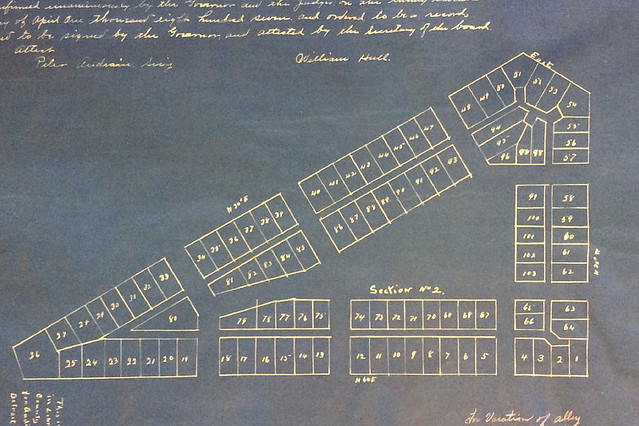


Courtesy of the Archives of Michigan.

This is more or less the plan that was finally implemented. On December 12, 1848 the Detroit City Council ordered that copies of Hull's 1807 plan be recorded by the Wayne County Register as a subdivision plat. Sections 1, 2, 3, 4, 6, 7, and 8 were recorded in liber 34, pages 543-550 in the county's book of plats on December 23, 1848. Sections 5, 9, 10, 11, and 12 were recorded on pages 551-555 of the same book on May 30, 1849. Cyanotypes of these pages were made July 6-10, 1916 for the State of Michigan, and can now be found in the Record of County Plats in the Archives of Michigan, volume 118, plat 8019. An online version is available here. Sections 13 and 14 were not recorded, and may never have been fully surveyed. They appear only on Philus E. Judd's famous "Plan of Detroit," drawn in 1824.
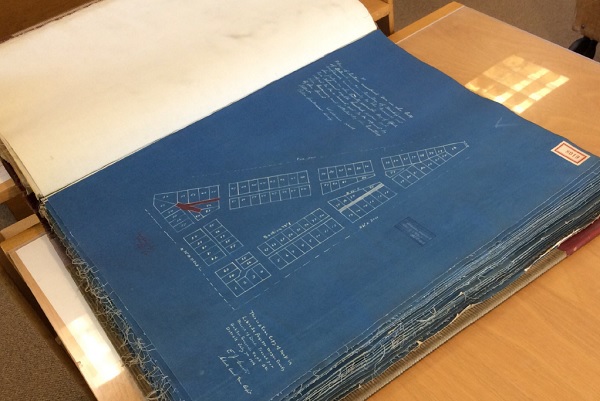

The new alley recesses seen in Hull's 1807 plan were criticized by Smith, who called this "theoretical improvement" a "deformity and a nuisance" to his original plan. He also believed that no churches, schools, or other buildings should be constructed in the center of the sections. In an 1831 letter to John R. Williams, he wrote that originally, these spaces "were for gardens and gravel walks, places of deposit in the event of fires and circulation of air," but that Woodward "caused (them) to be filled up with lots ... and obliged subsequent Surveyors to perform his whimsical schemes.... The Plan in its original form drew the attention of scientific persons, and from its novelty, it is to be regretted it was not continued."


"The Satisfaction Due to a Gentleman"


In addition to surveying the city, Abijah Hull was also supposed to mete and bound the private land claims around Detroit, a necessary step in confirming the new government's recognition of their ownership. On August 1, 1807, commissioners of the Detroit Land Office--Stanley Griswold, James Abbott, and Peter Audrain--wrote to the Secretary of the Treasury Albert Gallatin to complain that Abijah Hull had not surveyed a single land claim because he was too busy laying out the new City of Detroit. Word of this complaint got back to Hull, who alleged that he had asked the commissioners for instructions and for the names of the farmers whose land was to be surveyed on multiple occasions, but was ignored.

Hull confronted the commissioners on at least three occasions, demanding to see a copy of the letter they sent to Gallatin. At one point he was promised a copy, but the commissioners later changed their minds. Hull furiously drew up a public denunciation of Griswold and Abbott and nailed it up at some conspicuous location in the city on November 6, 1807. "To act openly and expose villains is the duty of every honest man," it began, "for the roguery of Rogues ought ever to be made public." Hull went on to explain all that had happened up until that point, and closed with the following remarks:
"Therefore the subscriber [Hull] told Stanly Griswold and James Abbott to their faces, that their writing in that way was a damm'd rascally piece of business, and that they were damm'd Rascals for doing it, and that Stanly Griswold was a liar."
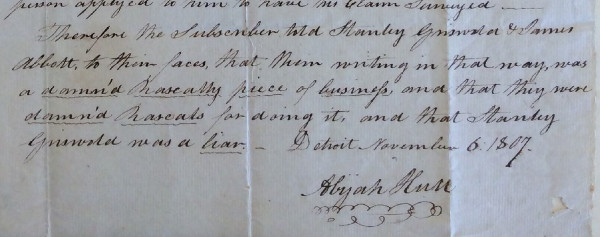
Detail from Abijah Hull's notice posted November 6, 1807.
Courtesy of the Archives of Michigan.

James Abbott shot back with his own public notice:
In a scurrilous piece published this day by Abijah Hull relative to Stanly Griswold Esq. and myself, I observe several falsehoods, consequently think it necessary to inform the public that the said Abijah Hull is not only a liar, but a Perjured Villain and as such he will be treated by
                                                                                          James Abbott.
With his mind already agitated by the hours of trigonometric calculations demanded by the Woodward Plan, Hull snapped. The following day, he challenged Stanley Griswold, the Secretary of the Territory of Michigan, to a duel via the following note:
Stanley Griswold, Esq.:
Sir--For reasons which must readily suggest themselves to you, I request that you will meet me as a gentleman this afternoon, at 4 of the clock, below the windmill at the Petite Cote, on the Canada side.
                                                                                          Abijah Hull.
La Petite Côte--the "Little Coast"--was in present-day Windsor, Ontario, about three miles downstream from Detroit. Griswold never showed up, prompting Hull to address the other land commissioner who had so gravely insulted him:
James Abbott, Esq.:
Sir--The language which you used respecting me in your publication of Saturday last imperiously demands satisfaction. As I conceive that no legal redress can give adequate compensation to injured character and insulted honor, I shall expect you to give me the satisfaction due to a gentleman by meeting me at 11 o'clock tomorrow morning at the windmill on the Petite Cote, on the other side of the Detroit river.
                                                                                          Abijah Hull.
Abbott, too, failed to meet his challenger. Hull was reportedly arrested for this behavior, but then bailed out by Elijah Brush.

Not ready to give up, Abijah Hull publicly posted a final notice on November 11, 1807. A surviving but badly torn copy reads:
Whereas Stanly Griswold, and James Abbott, under the cloak of their official duty as Commissioners, have complained to the Honorable, the Secretary of the Treasury of the United States, of me, in remissness of duty, as Surveyor for this District previous to my being authorized to proceed on the Surveys for the Claimants; and those very Honorable commissioners, having refused me a copy of the letter, altho' repeatedly called on both by myself and a friend, and having uttered and published base, malicious and villainous falsehoods, touching my Cha[racter] as a Citizen and a public officer, and [having] denied me that satisfaction due to [one] who feels himself aggrieved—— For [these rea]sons, the Subscriber feels it a du[ty to brand] them as Liars, Rascals, Scoundrels [who are] all destitute of manly courage, dastardly Cowards, beneath [the notice of] any Gentleman, and they will [be treated] as such by
                                                                                          Abijah Hull
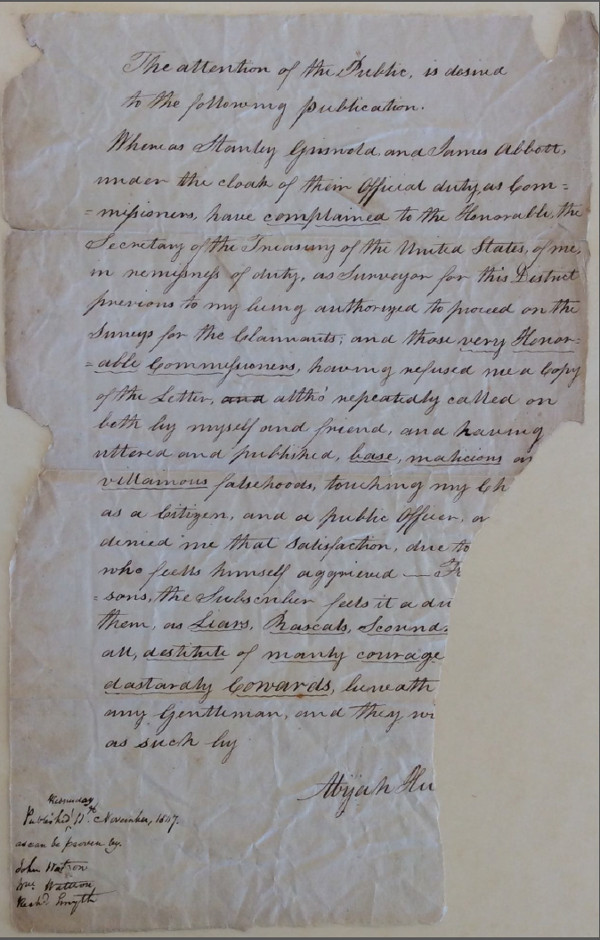
Abijah Hull's notice published November 11, 1807.
Courtesy of the Archives of Michigan.


The Aaron Greeley Affair


Griswold and Abbott wrote to the U.S. Surveyor General Jared Mansfield and his superior, Secretary of the Treasury Albert Gallatin, asking them to remove Abijah Hull and appoint Greeley in his place. Meanwhile, Griswold sent Greeley to Washington, D.C. to deliver a petition for the removal of Governor Hull and Justice Woodward. Gallatin acknowledged that the territory needed a surveyor who would "act in concert" with the land commissioners, but rather than remove Abijah Hull, Mansfield made Greeley an additional deputy surveyor in January 1808. Greeley, however, would not return to Michigan until the following May.

The troubles with Griswold finally ended when Thomas Jefferson removed him from office in March 1808. Still, Abijah Hull told Mansfield that he and McCloskey were only ready to continue surveying "provided we have nothing to do with Greely in the business." Mansfield declined to remove Greeley, simply making McCloskey yet another deputy surveyor that April. Hull complained to Mansfield again in May: "Since you informed me that Mr Greely was appointed to Survey the Claims I have declined acting altogether." Abijah Hull ultimately resigned on August 2, 1808.

Perhaps doubting McCloskey's abilities to continue work on the Woodward Plan, Governor Hull asked Thomas Smith to return to Detroit in October 1808, but Smith declined. McCloskey worked mostly in the city and in surveying a road to Ohio, while Greeley chiefly focused on the private claims. Greeley did however draw up his own rendition of the city plan, but it has not survived.
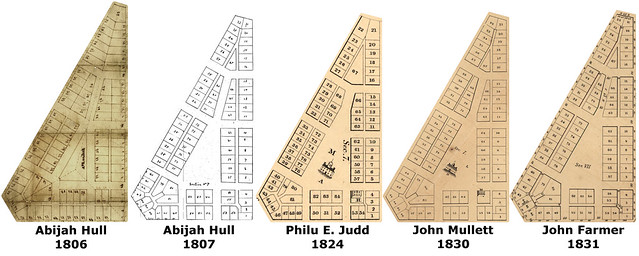

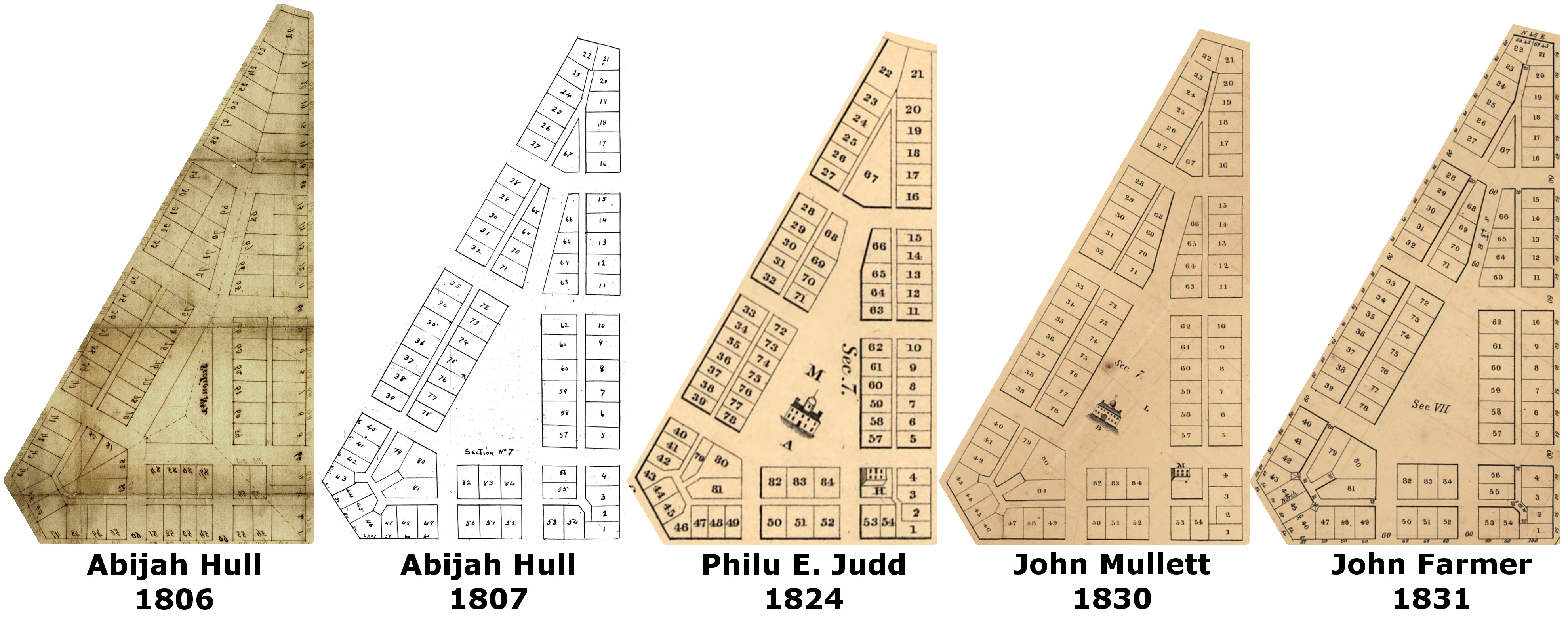
The subtle but important differences between versions of the plan become apparent in a side-by-side comparison of a sample section.
CLICK HERE FOR THE FULL SIZED VERSION OF THIS IMAGE.


The McCloskey Plan


In late 1808 and early 1809, Woodward was away in Washington, D.C. In his absence, McCloskey proposed that the Woodward Plan be abandoned. At a meeting of the governor and judges on November 21, 1808, McCloskey presented a sketch of an entirely new street layout in an ordinary gridiron pattern. Governor Hull liked the idea and proposed that a full and proper plan be drawn up. The motion passed, with Justice James Witherell voting for and and Justice John Griffin voting against it.

William Flannagan, a friend of Woodward's, immediately informed him of what had happened. "The mighty complex city of Detroit is to be reduced down to a plain scale," he wrote. Flannagan claimed that Governor Hull and Justice Witherell hired McCloskey "in their individual capacities, because the subject has never been agitated in the board, and moreover Mack [McCloskey] told me yesterday, when he produced me his new plan, that he had been requested to keep the matter secret for the present, that the governor and Judge Witherell had promised to see him well paid, and were sanguine in what they had undertaken."

On November 29, a meeting of about thirty citizens was held to discuss this change. Of all who attended, only a single individual, William Scott, spoke in favor of the McCloskey plan. As Flannagan reported, "After the matter was thoroughly discussed a motion was made for the meeting to disperse; it did so without taking any question. The commissioners are now pursuing the old plan, and they promised to make thorough work."

Although the Woodward Plan was safe for the moment, Governor Hull had grown to hate it. He was mortified when Woodward, dismissing fears of an Indian attack, proposed that the fortifications surrounding the city be removed. Woodward's suggestion could only have arisen "from his devotion to his darling child, the plan of the City of Detroit," Hull wrote just after McCloskey's plan failed to garner support.
It is deeply to be regretted that [Woodward] ever had influence sufficient to have brought that plan into existence—It is certainly the most unfortunate act of the administration of this Government—In experiment it is found to be illy adapted to the situation and circumstances of the town.
Several weeks later, with Woodward yet to return, the governor and judges repealed the act incorporating Detroit into a city ("An act concerning the city of Detroit") on February 24, 1809, reverting it back to township status, as if to send the message that Detroit's top priority was military protection, not city planning. Nevertheless, the law which codified the Woodward Plan, "An act concerning the town of Detroit," was not repealed.
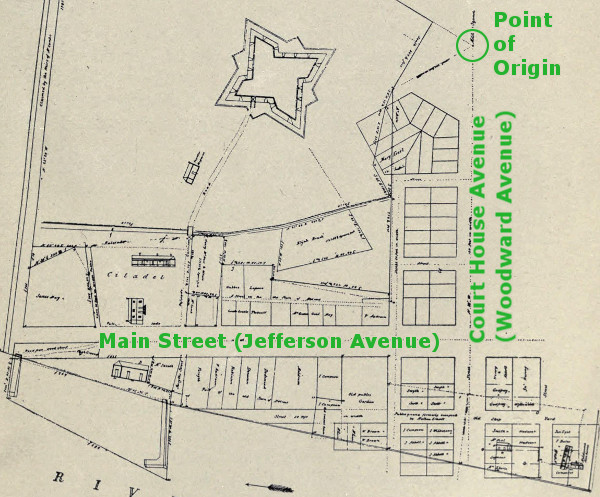

The Military Reserve and surrounding parcels in 1809, shown encroaching
upon Section 2 and obstructing Section 5 completely.
(Source.)


Thomas Smith Returns


Detroit's urban planning activities weren't merely interrupted by the War of 1812, they were thrown into complete disarray when the occupying British officers destroyed or confiscated many territorial documents, including plans of the city. The situation was so bad when Michigan's new governor, Lewis Cass, took office in 1813, the government found it was unable to continue selling lots or issuing deeds until its land records were straightened out.

The only person capable of restoring order to the confusion was Thomas Smith, the original surveyor of the Woodward Plan. He returned to Detroit and began drawing up yet another master plan in 1816, based on his own knowledge in addition to whatever documents could be cobbled together. In assessing the "irregularities which have crept into the survey of the city," even before the war, he reported that his original plan
fell into the hands of Mr. [Abijah] Hull, (surveyor,) who drew from it several other plans, different from the original, and also differing with each other, as well in the measurement as in the numbers of lots. Deeds were issued upon all those plans, and no regular record was kept, so it became impossible to know what lots were granted or ungranted.

Subsequently the original plan fell into the hands of Aaron Greely (Surveyor) in whose House it was seen in A broken window keeping out the weather, and in whose hands it disappeared.
Smith found inconsistencies in the method of numbering of lots within a section, which led to some lots being granted to more than one owner. Some deeds described lots wider or narrower than they appeared on the plan, while others inadvertently included portions of streets and alleys. Smith also reported that many lots were measured using a surveyor's chain that was too short!
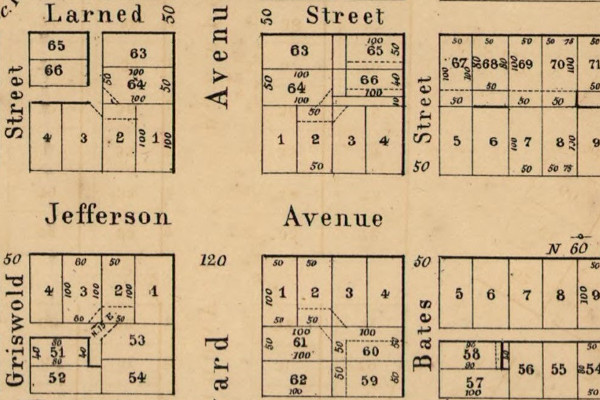

This 1831 plat by John Farmer outlines discrepancies with dotted lines. (Source.)

Smith ably completed his task, albeit with much difficulty. Among his more unusual solutions in reconciling the conflicting lot numbering systems was to assign the ungranted lots two numbers. "That is of no consequence," he reported to the governor and judges, "as it is as easy to describe a lot with two numbers, as one." He also recommended that the 200 foot streets be narrowed, that the streets inside the sections be closed, and that the excess land be attached to the adjacent lots, but it doesn't appear that these suggestions were ever seriously considered.

After the years of work that went into repairing the plan, only a very small part of the city was platted accordingly. How it came to be that way will be explored in part three of this article.


* * * * *


Architectural Legacy of the Woodard Plan


Special thanks to Michelle and Chris Gerard, who very generously provided all of the following photographs. Click on any image to see a larger version.
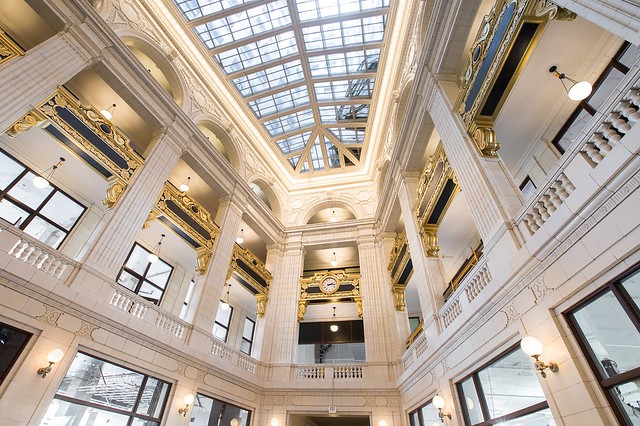

The David Whitney Building - Lots 20-23, Section 8.
Photo courtesy Michelle and Chris Gerard.

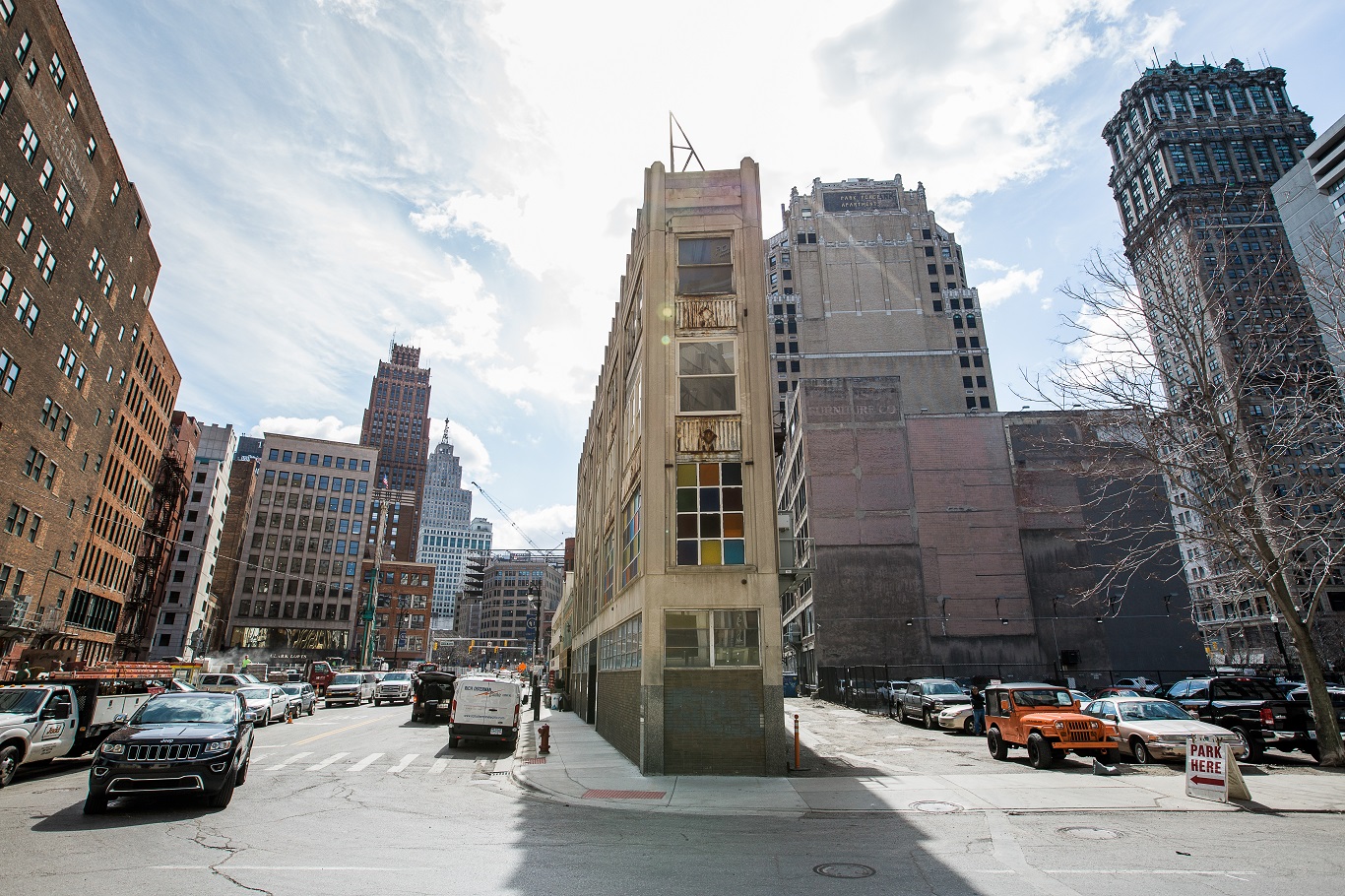
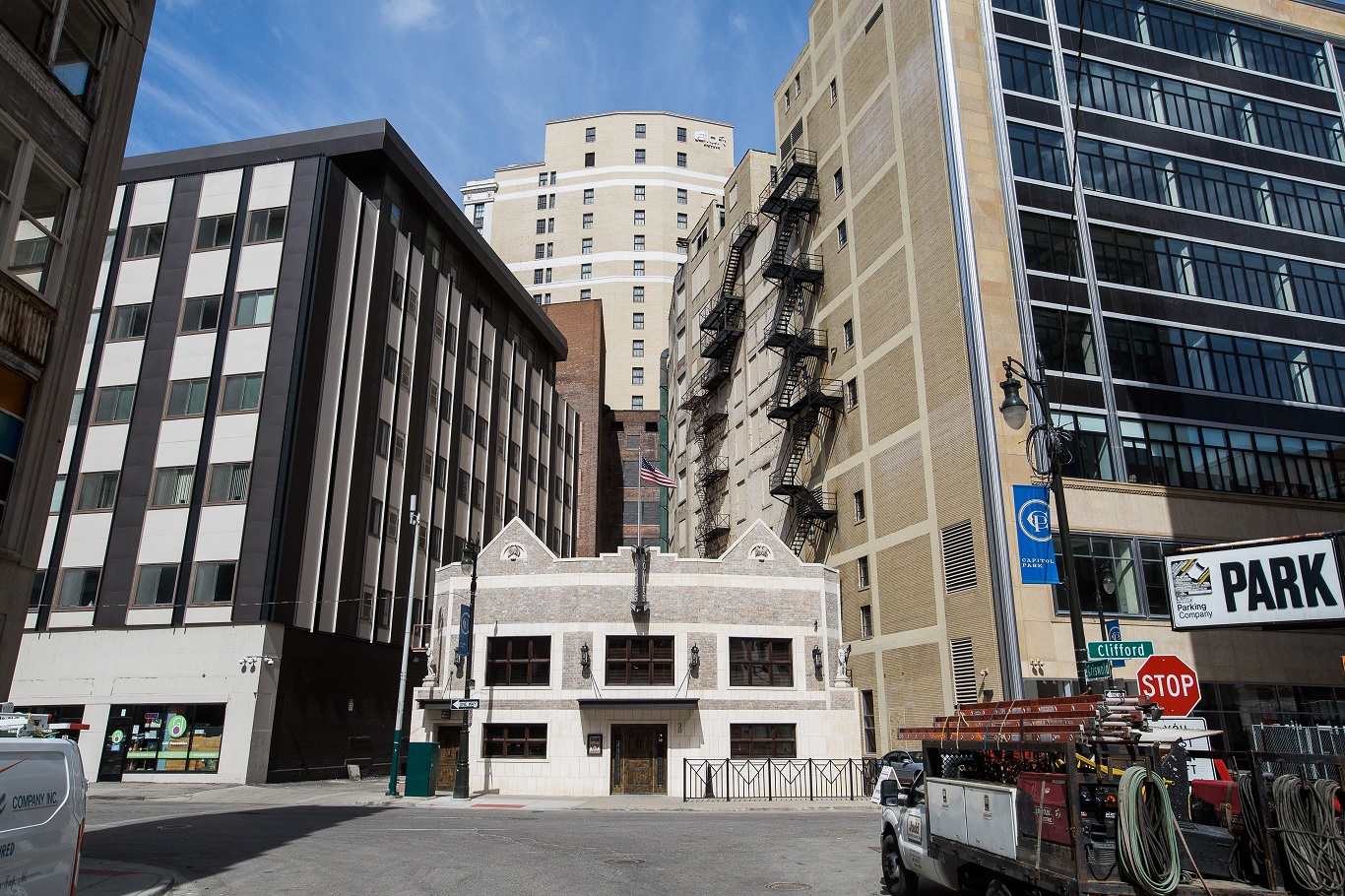
Although most of the lots in the Woodward Plan are ordinary rectangles, it is the plan's irregular parcels and unusually angled streets that give the center of the city its distinct character. Historian Silas Farmer put it best:
No one who studies the original plan can avoid wishing that it could have been adhered to. The portions of the city of which we are most proud and which are most admired by strangers, our main avenues, the Campus Martius, the Grand Circus, and the smaller public squares, are all parts of Judge Woodward's plan. His diagonal streets and avenues have produced several locations of special prominence which afforded exceptional opportunities for architectural display. Peculiar and pleasing vistas result in many places from the triangular intersection of streets arranged for in his plan.
—Silas Farmer
, The History of Detroit and Michigan. (1884)
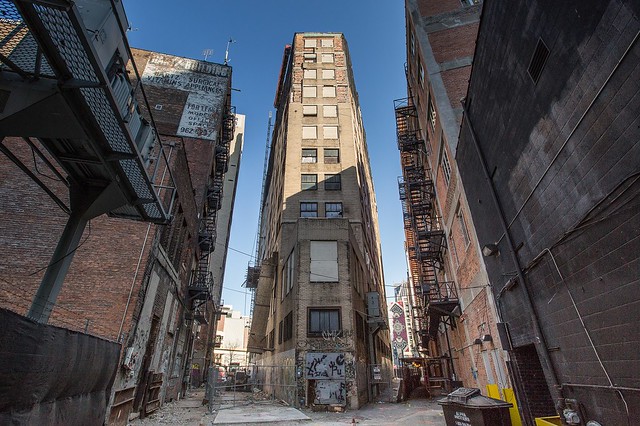

Metropolitan Building (rear) - Lot 67, Section 7.
Photo courtesy Michelle and Chris Gerard.
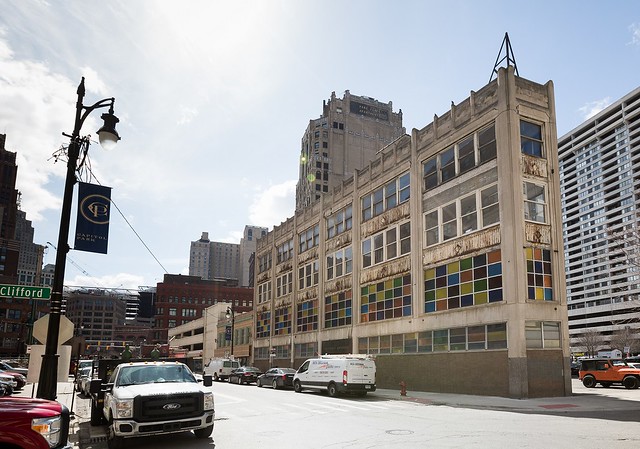

Isaac Agree Downtown Synagogue - Lot 65, Section 8.
Photo courtesy Michelle and Chris Gerard.
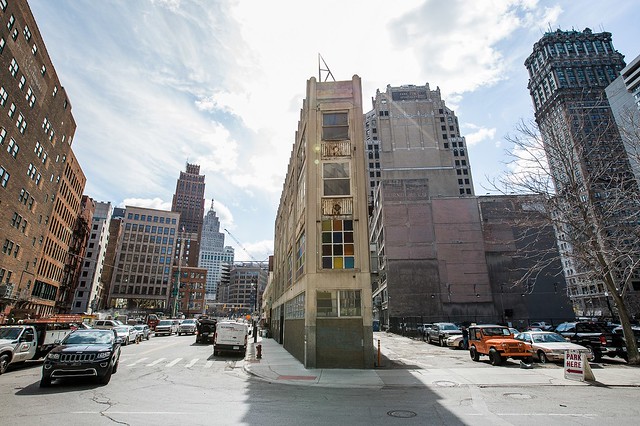

Isaac Agree Downtown Synagogue - Lot 65, Section 8.
Photo courtesy Michelle and Chris Gerard.

The genius of the Woodward Plan is that it satisfies seemingly opposite human needs--of grand, open places on the one hand, and of close and intimate urban spaces on the other--or the desires for both novelty and uniformity. Somehow they're all included, in just the right proportions, within a unified, repeatable system, still relatable two centuries after its creation.
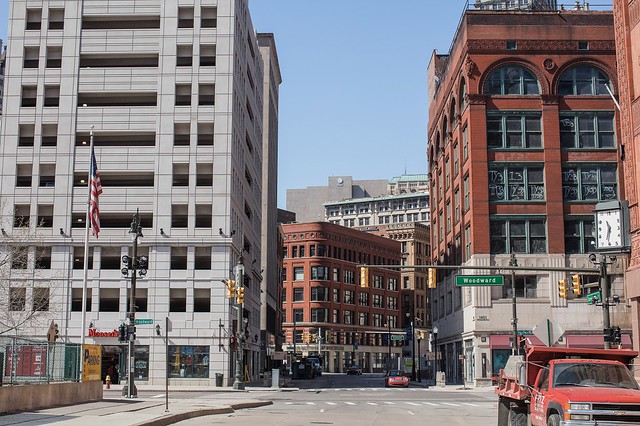

Looking toward the interior of Section 8 from Grand River Ave. and Woodward.
Photo courtesy Michelle and Chris Gerard.
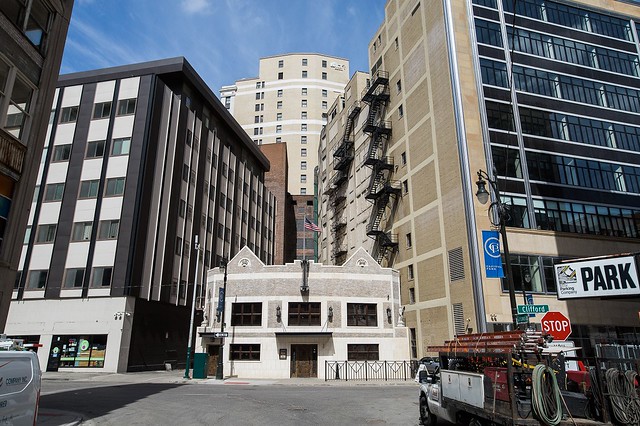

Louie's Lounge - Lot 82, Section 8.
Photo courtesy Michelle and Chris Gerard.
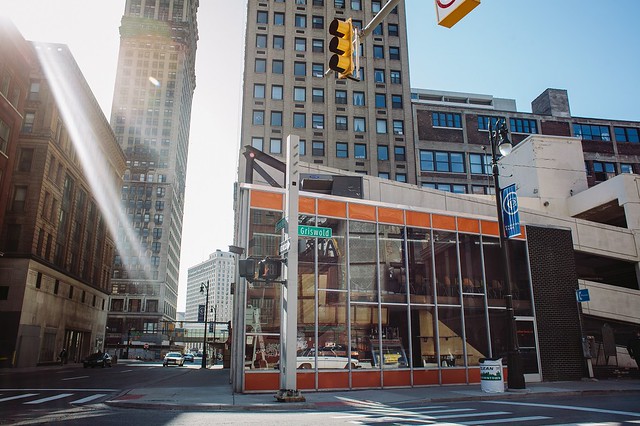

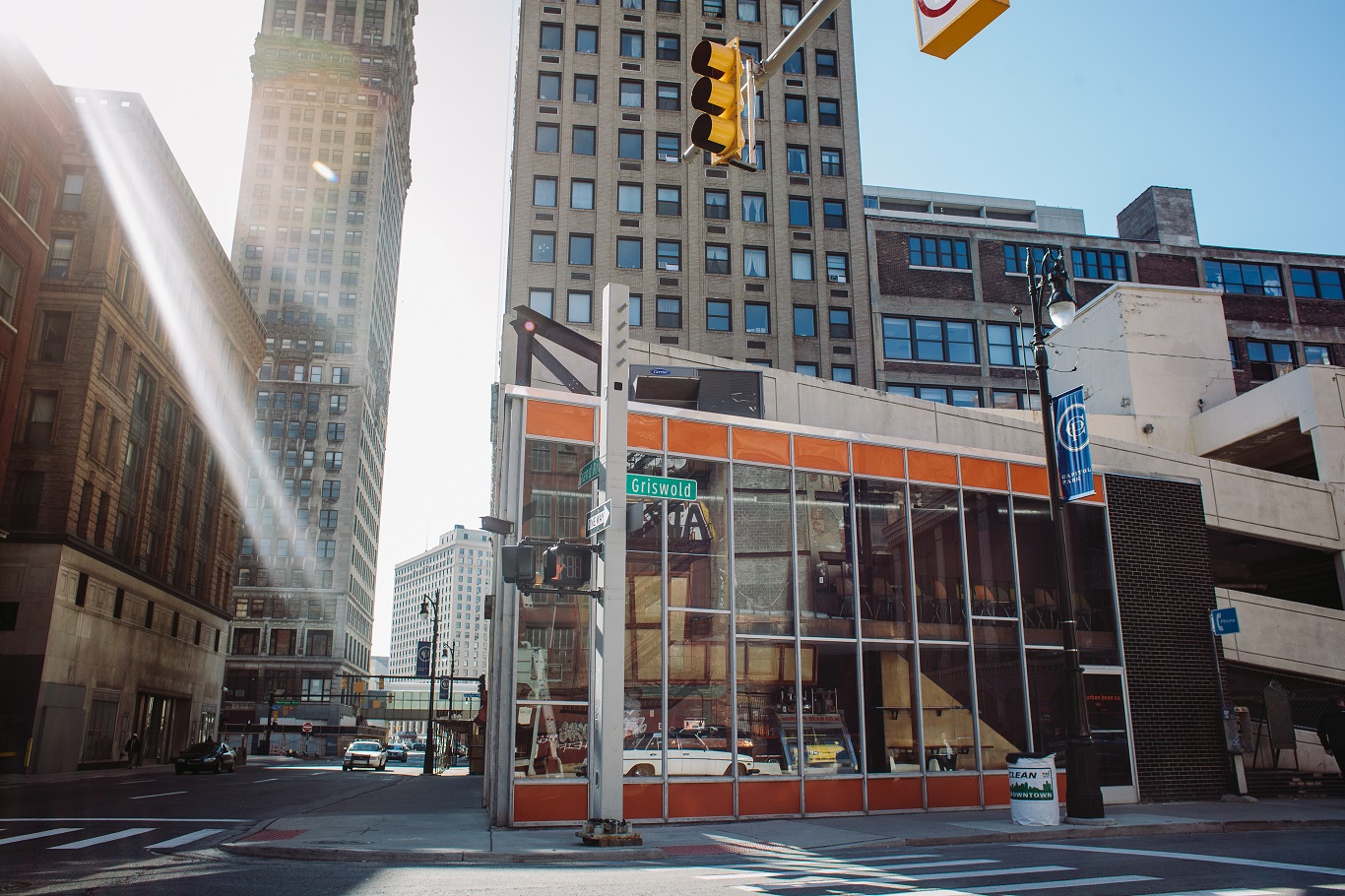
Urban Bean Company - Part of Lot 63, Section 8.
Photo courtesy Michelle and Chris Gerard.

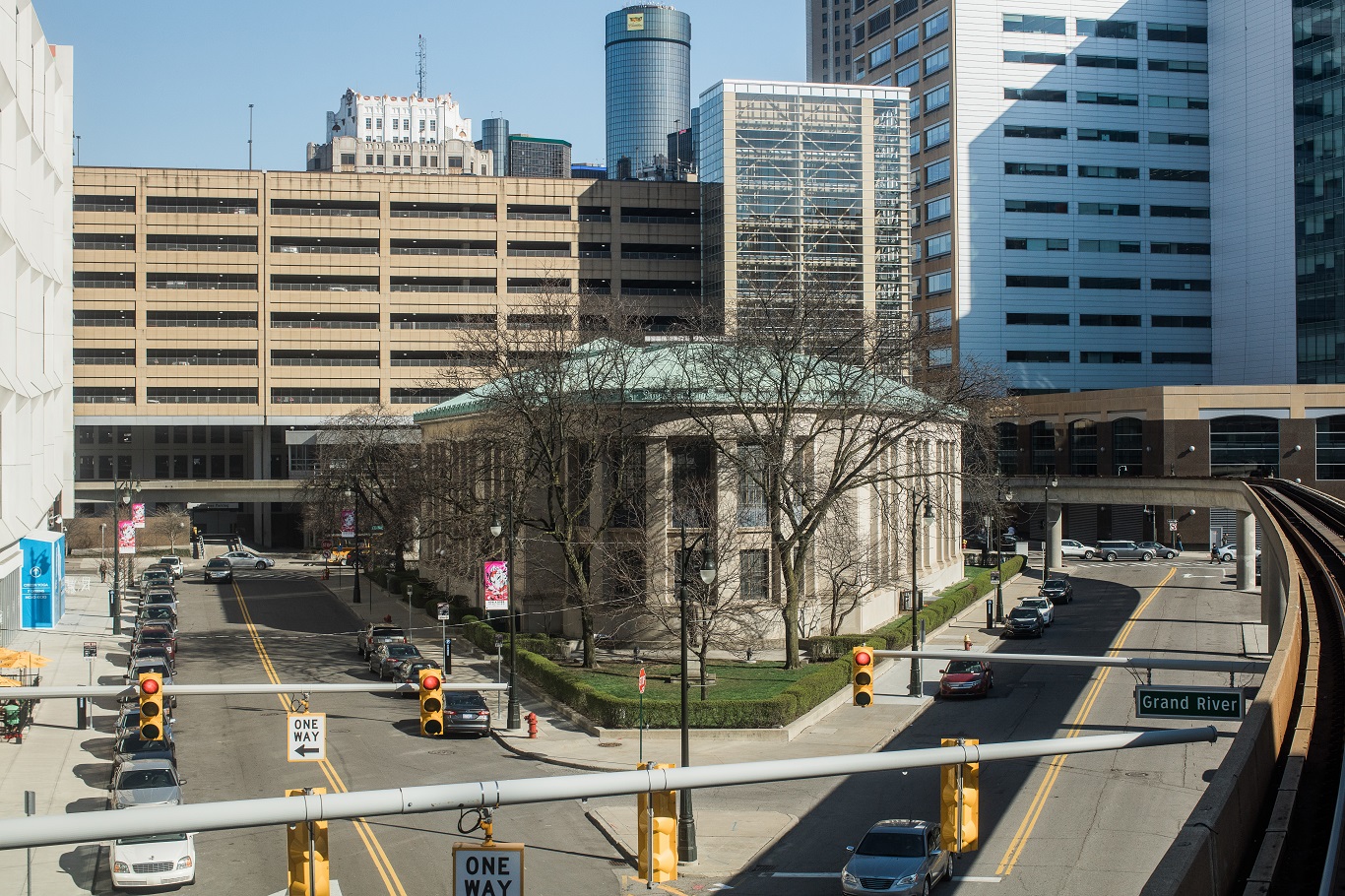
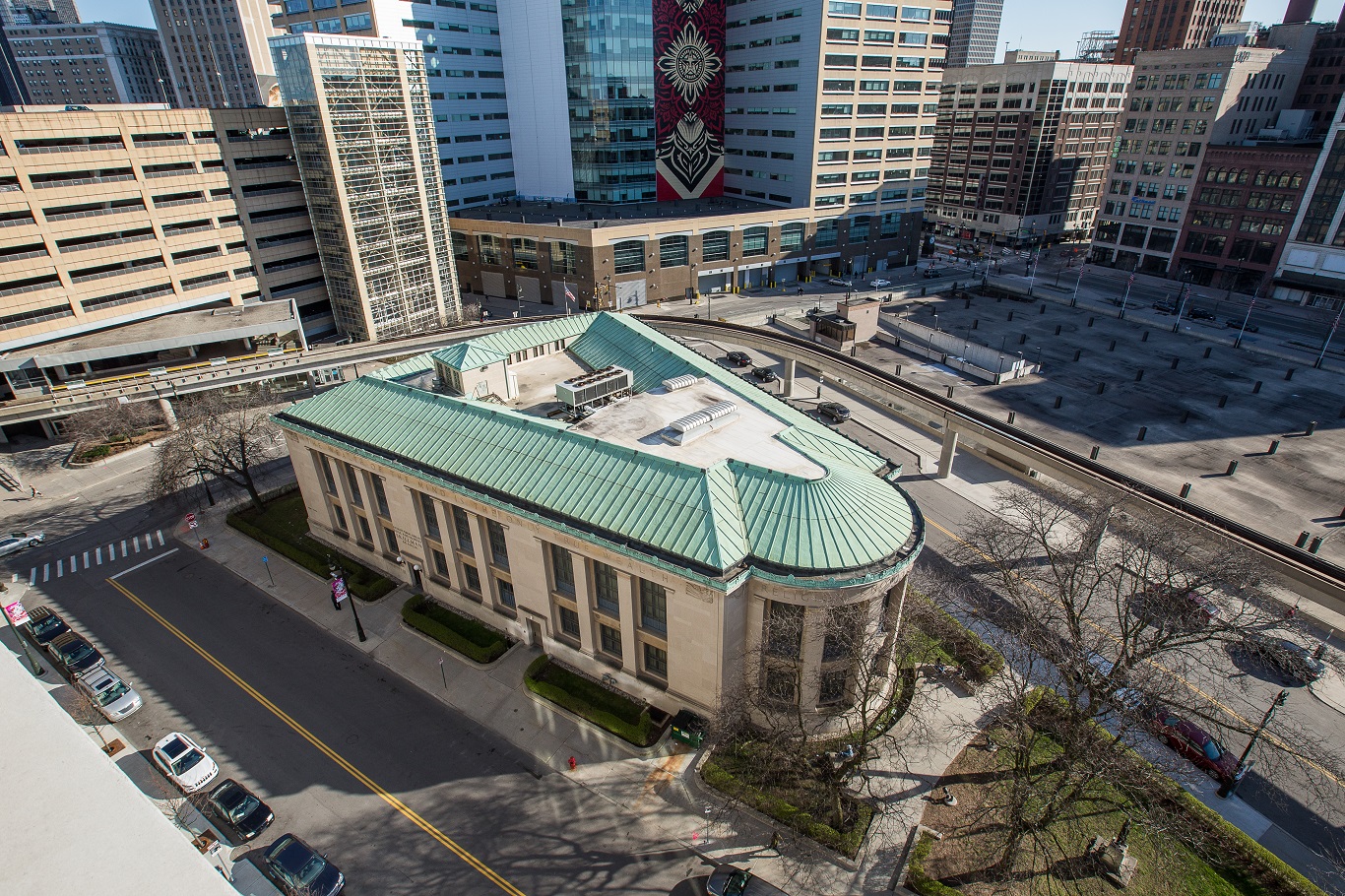
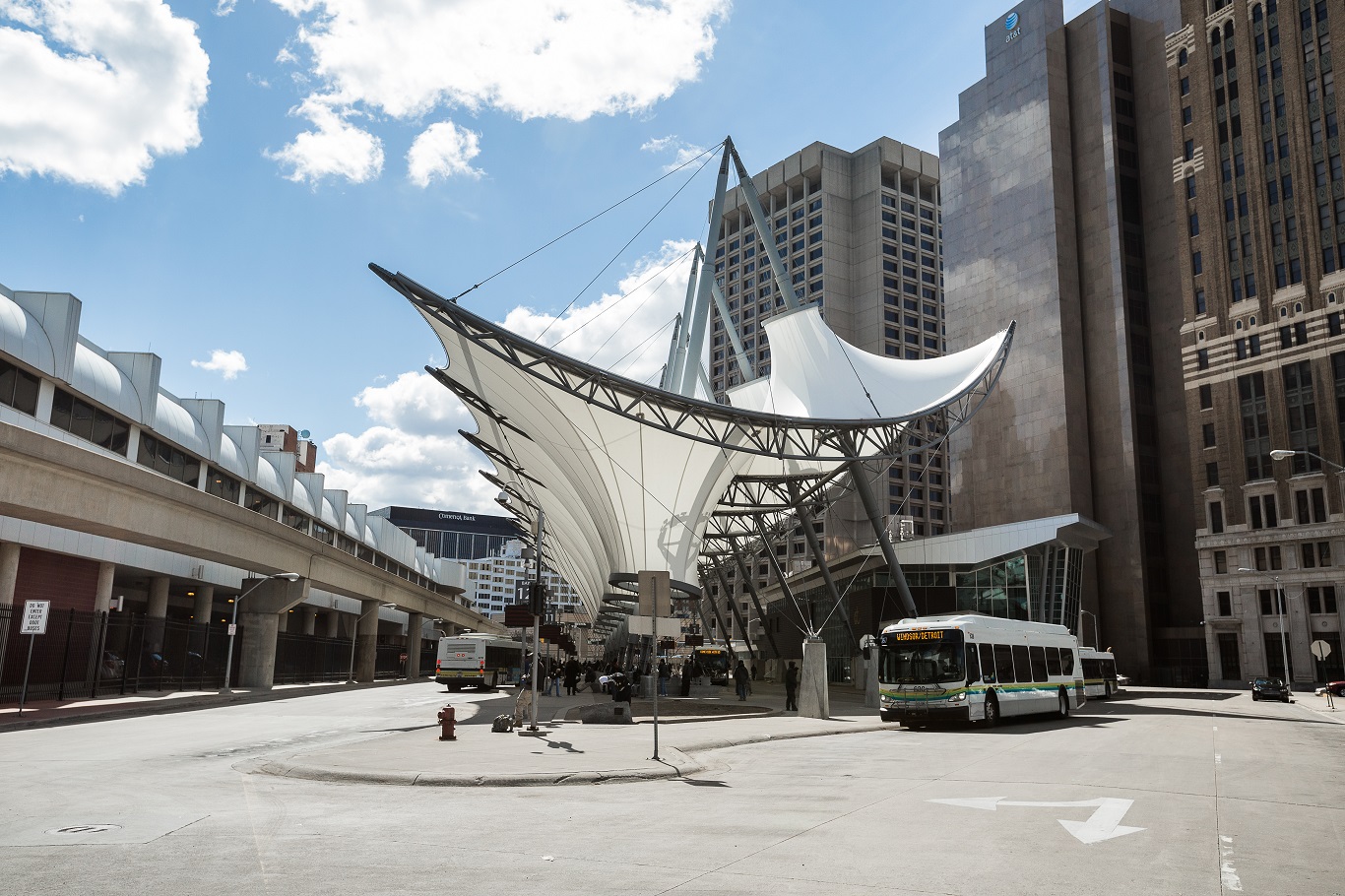
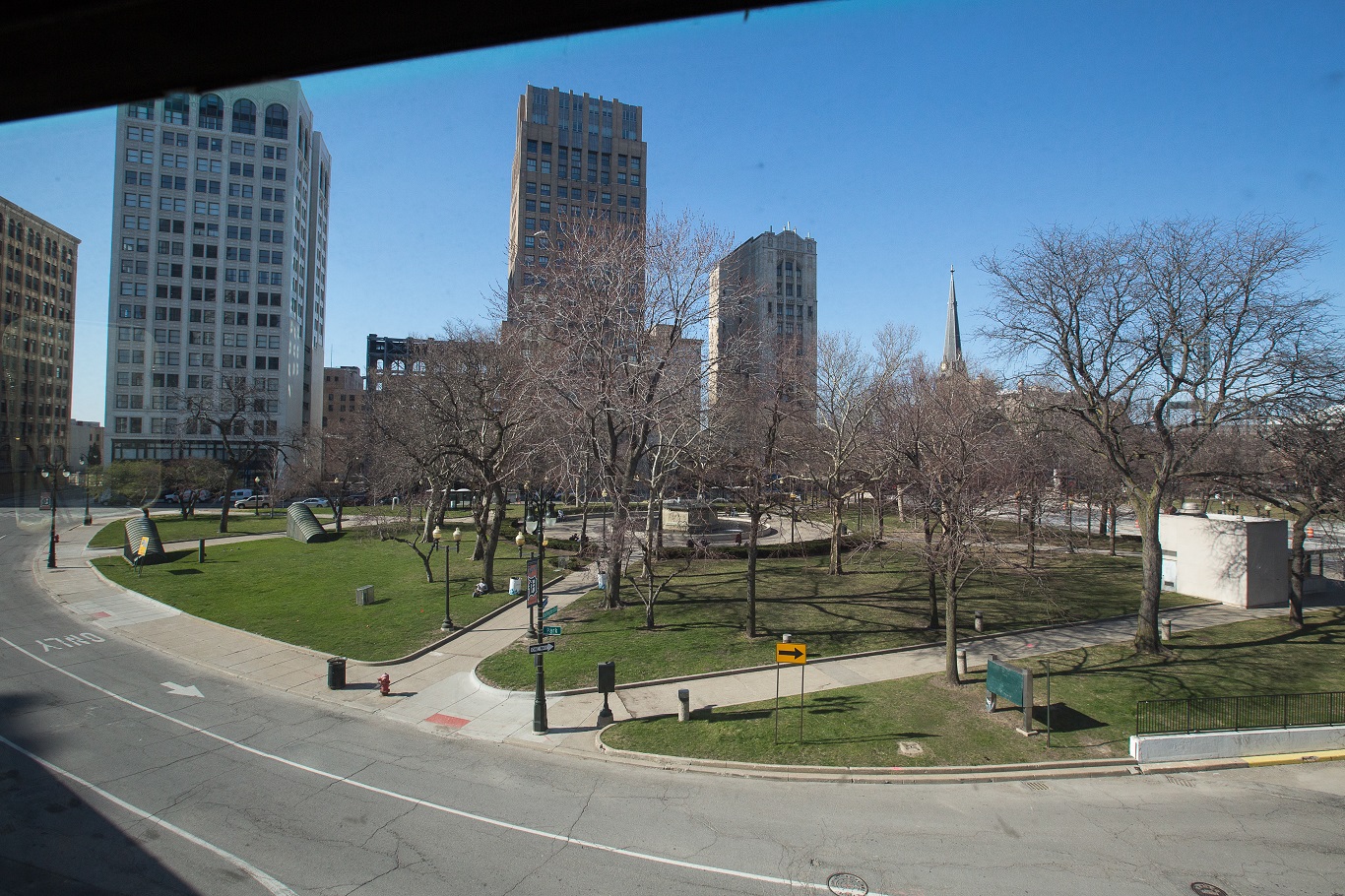
The triangular lots at the center of each section remain public spaces just as Judge Woodward envisioned.
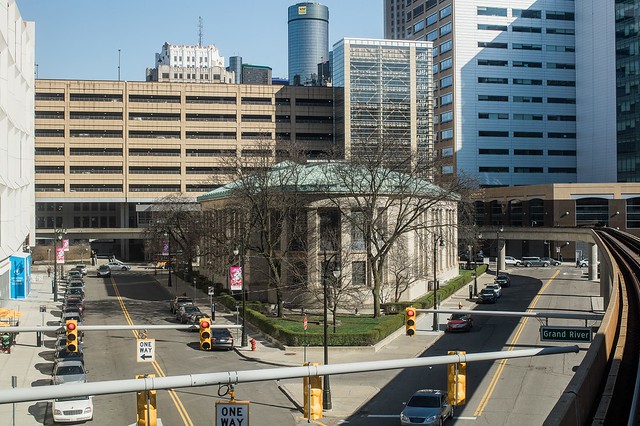

The Skillman Branch Library - Center of Section 7.
Photo courtesy Michelle and Chris Gerard.
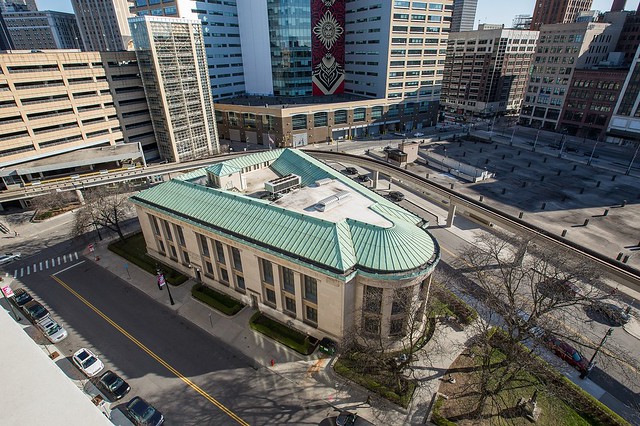

The Skillman Branch Library - Center of Section 7.
Photo courtesy Michelle and Chris Gerard.
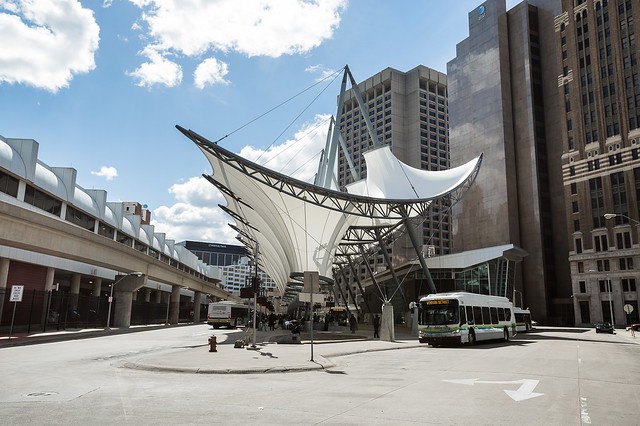

Rosa Parks Transit Center - Center of Section 10.
Photo courtesy Michelle and Chris Gerard.
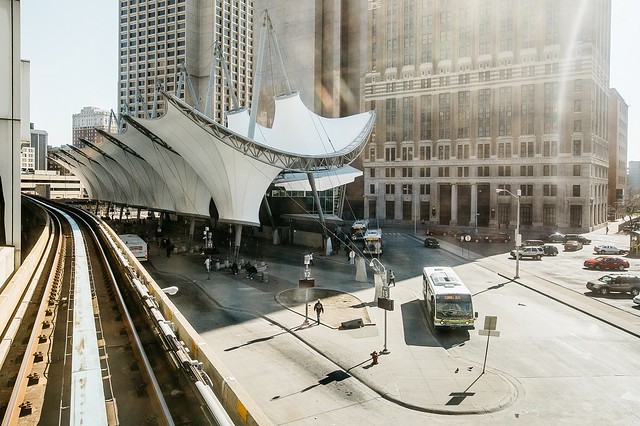

Rosa Parks Transit Center - Center of Section 10.
Photo courtesy Michelle and Chris Gerard.
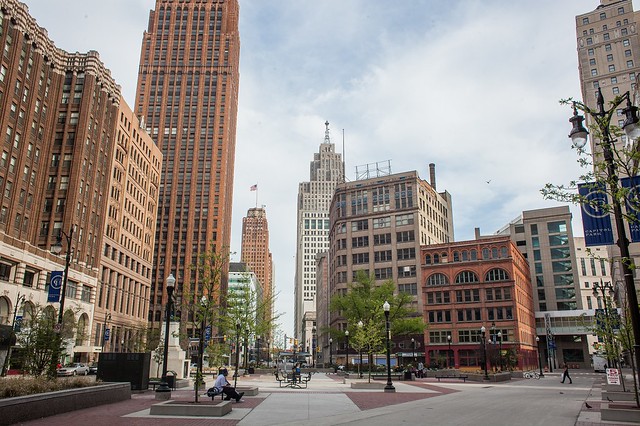

Capitol Park - Center of Section 8.
Photo courtesy Michelle and Chris Gerard.
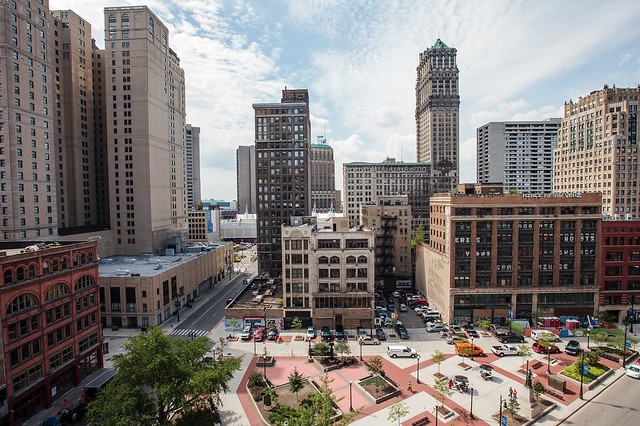

Capitol Park - Center of Section 8.
Photo courtesy Michelle and Chris Gerard.
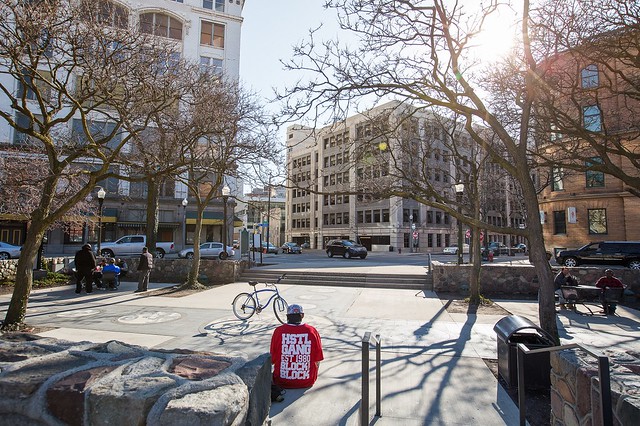

Harmonie Park - Center of Section 9.
Photo courtesy Michelle and Chris Gerard.
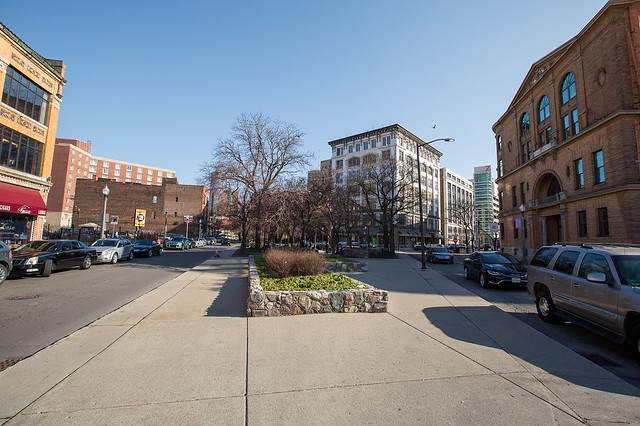

Harmonie Park - Center of Section 9.
Photo courtesy Michelle and Chris Gerard.
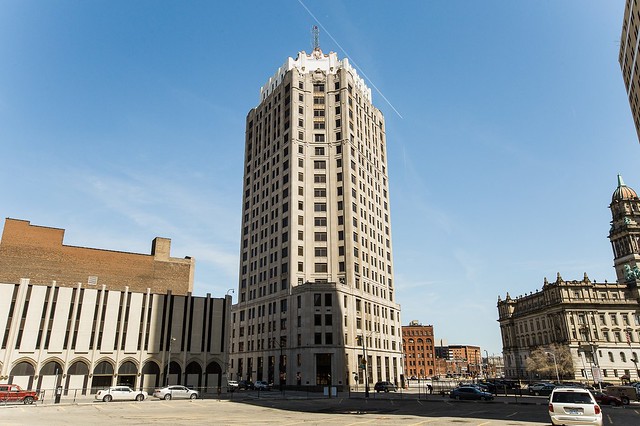

The Detroit Water Board Building - Center of Section 6.
Photo courtesy Michelle and Chris Gerard.

"Are cities built in a day? Can you throw them down, when your ground-plan is found contracted and inconvenient, and erect new ones on a better ground-plan, among the ruins of the old? ... No, cities are the work of time, of a generation, of a succession of generations. ... A proper and prudent foresight can alone give to a great city its fair development. Order, regularity, beauty, must characterize its original ground-plan."
                                                     —Augustus Woodward
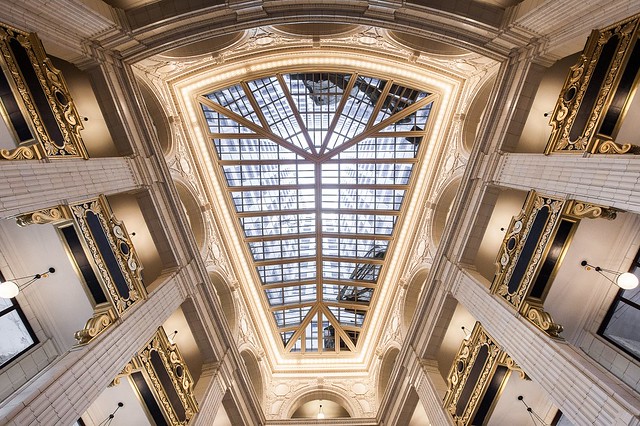


The David Whitney Building - Lots 20-23, Section 8.
The shape of this skylight is dictated by the Woodward Plan.
Photo courtesy Michelle and Chris Gerard.
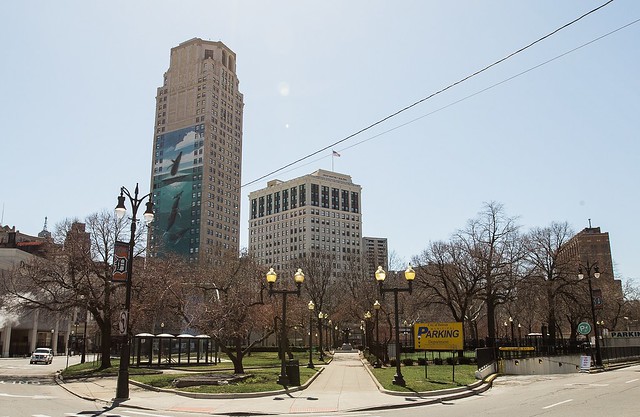

Grand Circus Park.
Photo courtesy Michelle and Chris Gerard.
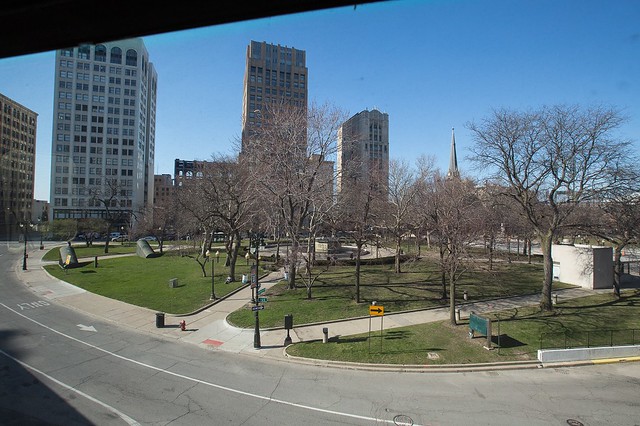

Grand Circus Park.
Photo courtesy Michelle and Chris Gerard.
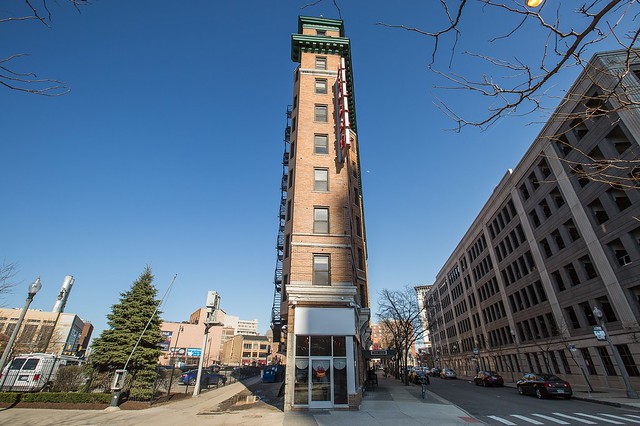

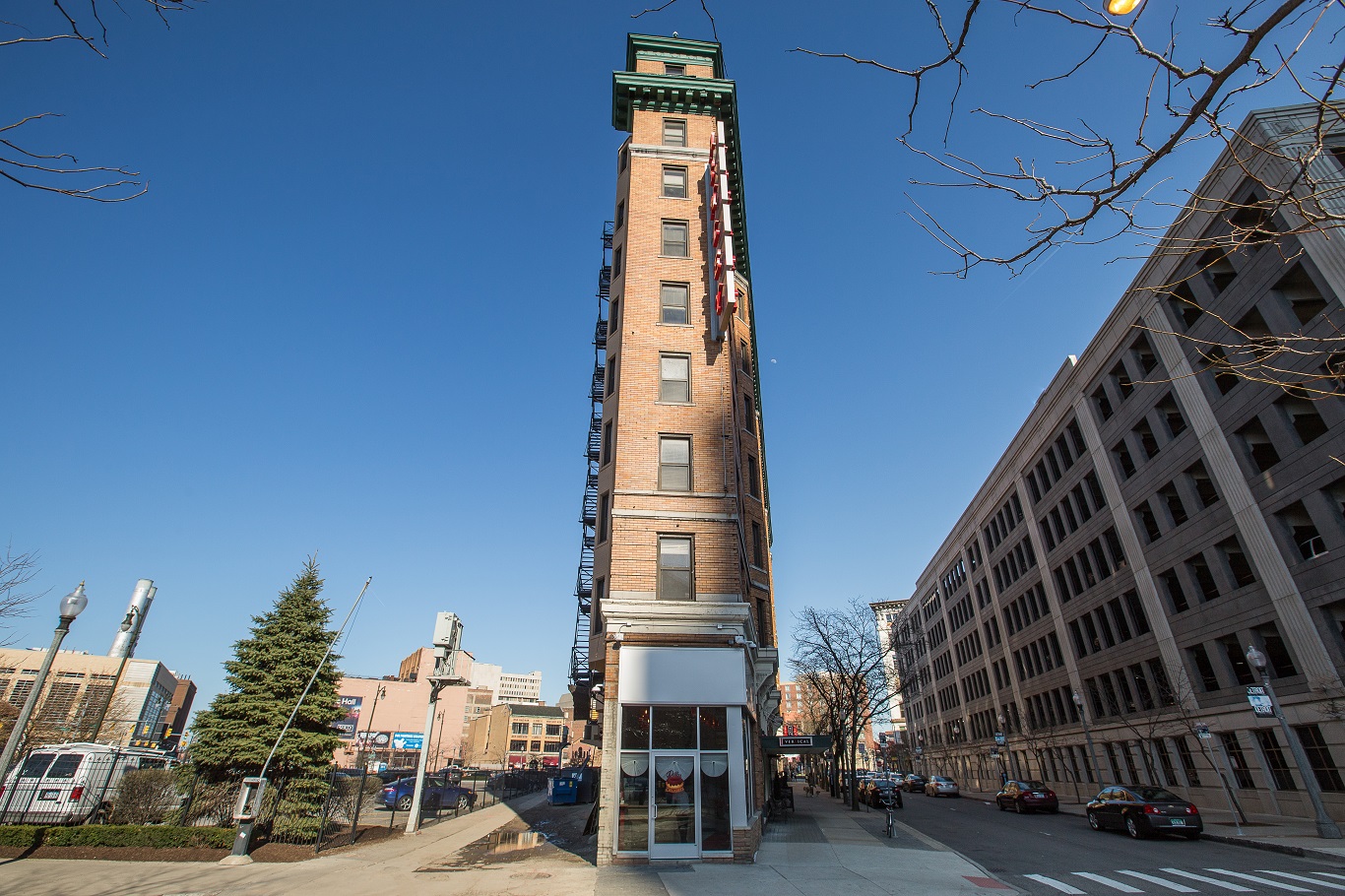
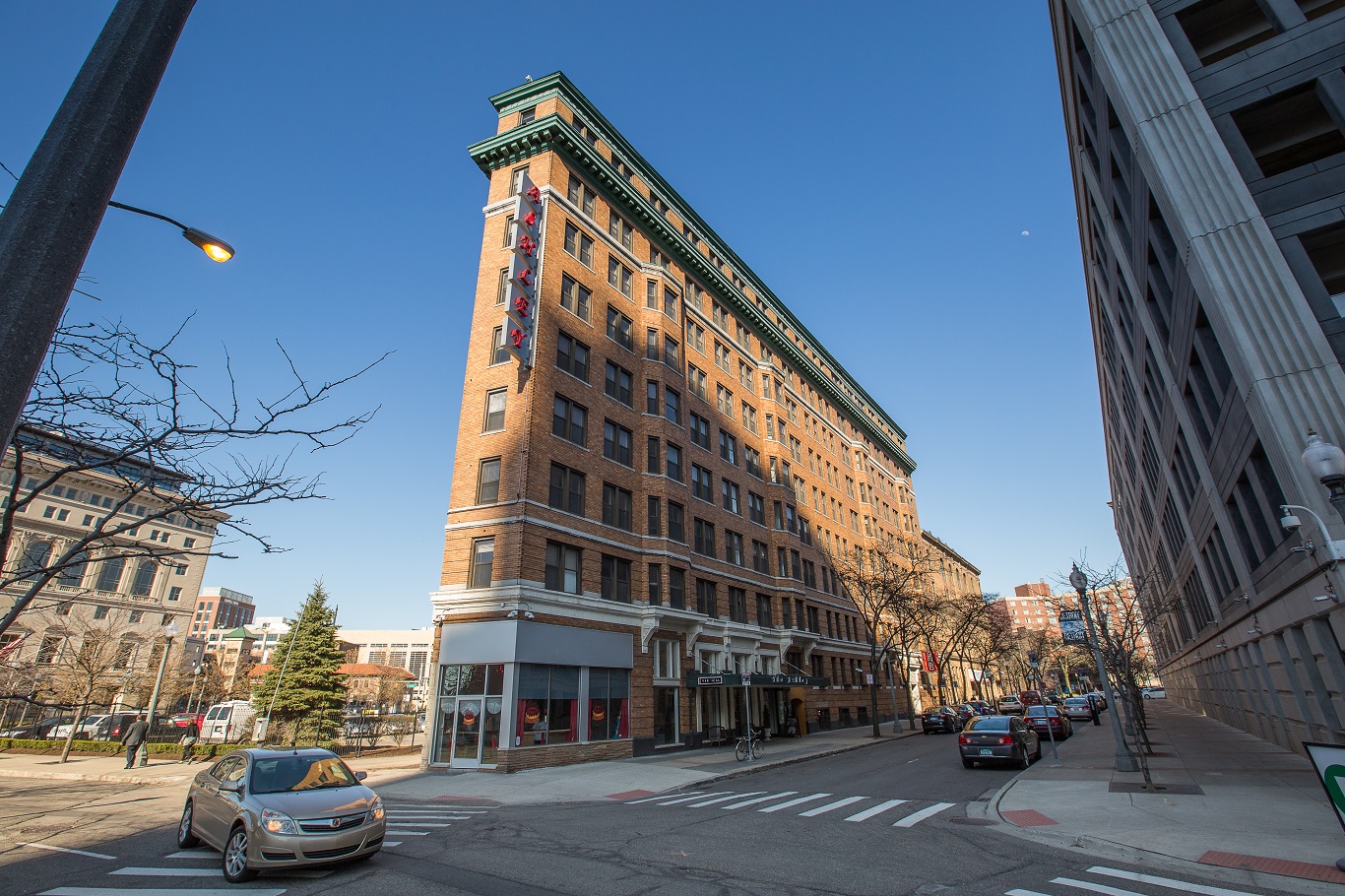
The Henry Clay Hotel, aka The Ashley - Lots 68 & 69, Section 9.
Photo courtesy Michelle and Chris Gerard.
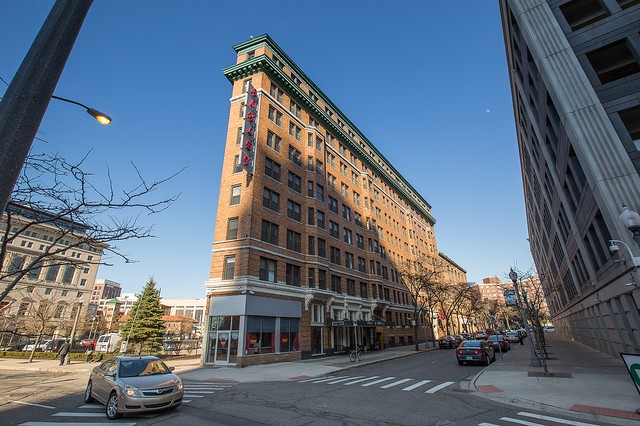

The Henry Clay Hotel, aka The Ashley - Lots 68 & 69, Section 9.
Photo courtesy Michelle and Chris Gerard.


One Campus Martius - Lots 40-49 & 79-81, Section 7. Like the David Whitney building, the shape of the lobby and skylight reflects the block on which it stands.
Photo courtesy Michelle and Chris Gerard.

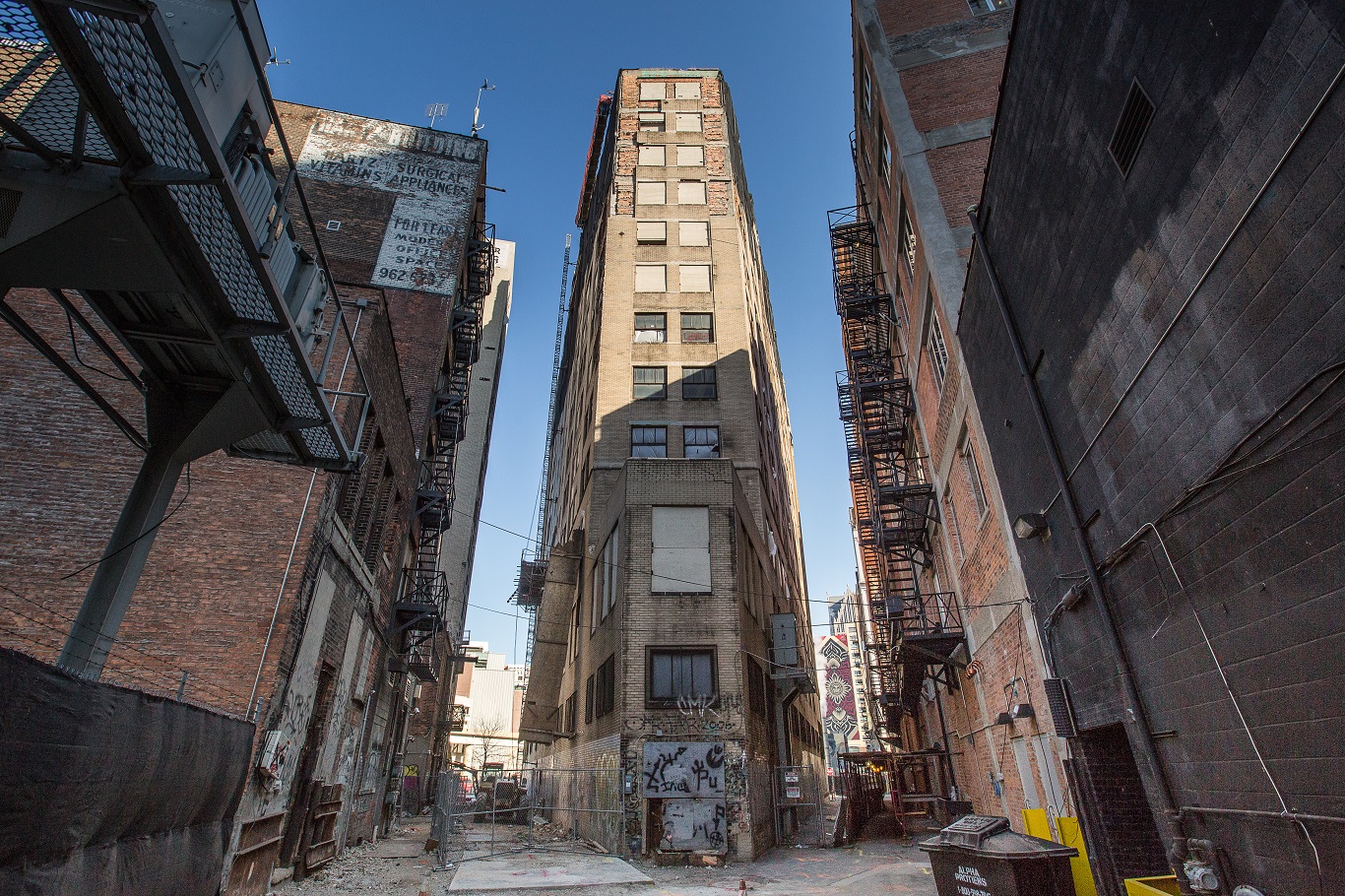

One Campus Martius - Lots 40-49 & 79-81, Section 7.
Photo courtesy Michelle and Chris Gerard.


* * * * *

Click here to continue to The Woodward Plan Part III: Interruptions.