Tuesday, January 19, 2016

Retracing Detroit's Native American Trails

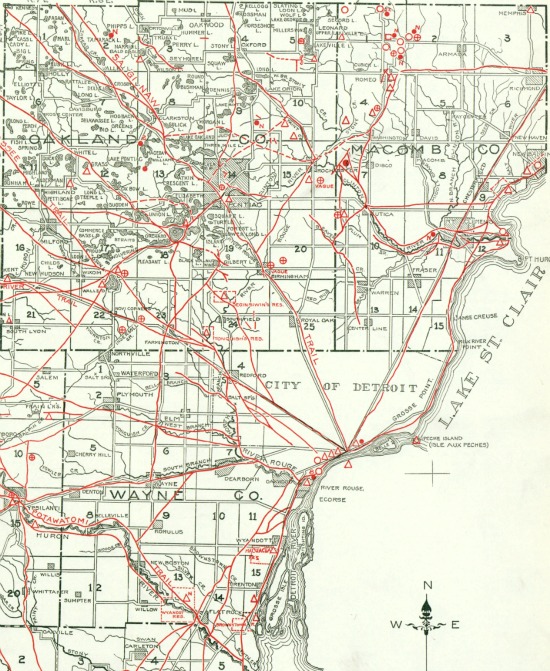
The most fascinating thing to me about Native American trails isn't just that Detroit was a hub in a continent-wide network of footpaths worn into the earth centuries before Cadillac or Columbus--it's that some of these paths have been preserved as modern roads and highways, and today we can still walk in the footsteps of the civilizations that came before us.


From Archaeological Atlas of Michigan, but Wilbert B. Hinsdale. (Source.)

I first learned about this on a childhood visit to my grandparents' house in Clinton Township. There was a historical marker a few blocks from their subdivision, and I asked my grandpa what it said. He told me that it said Moravian Road, where it was located, was originally a trail cut through the wilderness by Delaware Indians to connect their Moravian village to Detroit.
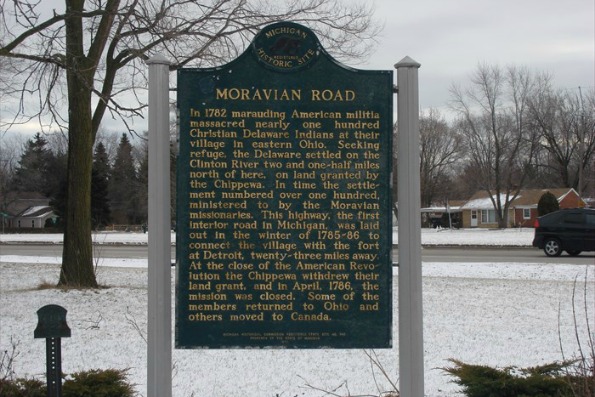

The historical marker at Moravian Road and Metropolitan Parkway.
Image courtesy waymarking.com.
(Source.)

The Moravian Trail is young, being "only" 330 years old. The establishment of Fort Pontchartrain in 1701 likely influenced the locations of some older trails, but many certainly existed since the time when the Mound Builders lived in southwest Detroit more than a millennium ago.
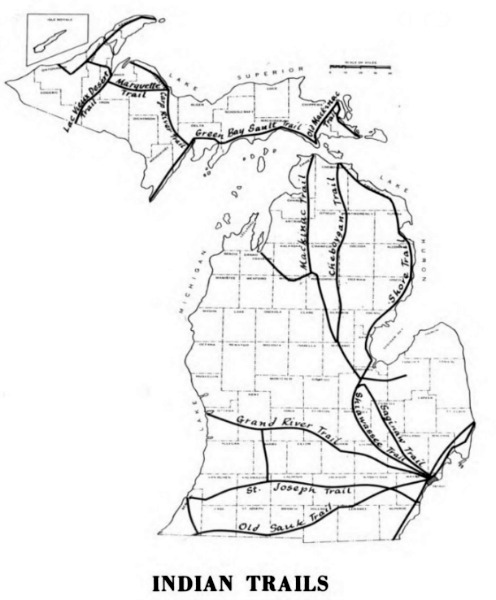

From Michigan Highways: From Indian Trails to Expressways, by Philip P. Mason. (Source.)

These trails were narrow, single-file passageways simply created by the earth being trampled along the paths most frequently traveled. But in a way, it was the land itself that created these highways. The Earth predetermines where humans will settle (on arable land, close to waterways convenient for transportation) and the most logical path between those settlements (high, dry, level land, avoiding swamps and other obstacles, and crossing rivers at their most narrow or shallow points). Some trails in Michigan trace glacial moraines deposited ten thousand years ago. Archaeologists hypothesize that roaming herds of animals were the first to travel these paths, showing the way to the hunters who followed them. When the Europeans came, they found that the best places to settle were the sites of former Native American villages, and they utilized and maintained the same trails between them.
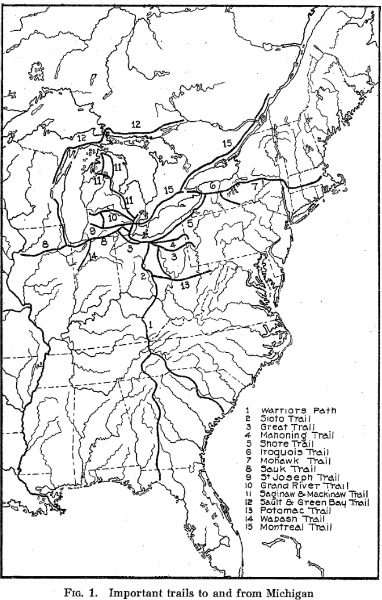

From Archaeological Atlas of Michigan, but Wilbert B. Hinsdale. (Source.)

You have probably already heard about roads that used to be "Indian paths." This isn't a new revelation. The question I'm interested is, How do we know that a certain road was once a Native American trail?

One source is the accounts of early settlers. The Pioneer Society of the State of Michigan was founded in 1876, the year of the United States' first centennial, to preserve the memories of the first white settlers of the state's interior before that generation had completely disappeared. They described seeking out and relying on the trails for their own needs, and later expanding them into wagon trails and roads.

But we have even better proof.


The U.S. Government Surveys


Following the 1807 Treaty of Detroit, all land in southeast Michigan that had not been settled upon before 1796 or designated an Indian reservation became property of the United States Government. In order for the land to be sold or used as payment, it needed to be surveyed. The first surveyors in southeast Michigan divided the land into six-mile by six-mile townships. At a later date these townships were subdivided into one-mile square sections. While imposing this massive grid onto the landscape, driving posts into the ground every half mile along their paths, surveyors had been instructed to note, among other observations: the condition of the soil and land; the type of timber or other growth; the boundaries of rivers, lakes and other bodies of water; and the locations of "all roads and trails, with the courses they bear." In theory, the surveyors' field notes should contain this data.

Take for example Farmington township, subdivided by Samuel Carpenter. His field notes show that he set a marker (probably a cedar post) at what is now the intersection of Farmington Road and Nine Mile Road on May 11, 1817. The post is long gone, but its exact location has been continuously preserved for nearly 200 years. Today, a modern surveyors' mark is on this very spot, protected by a cast iron cover:
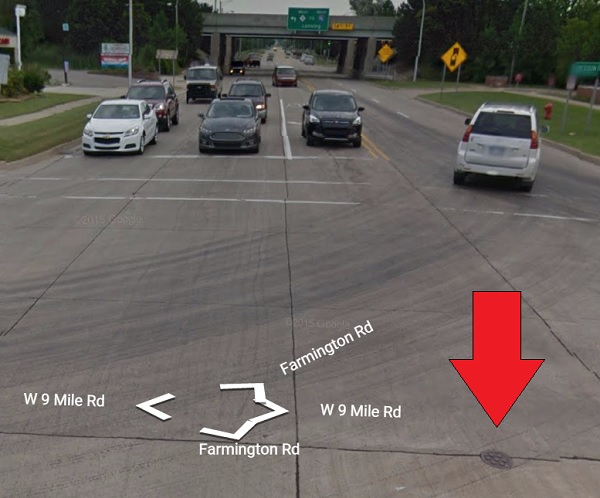

A survey marker in the intersection of Farmington and Nine Mile Roads.
Image courtesy Google Street View.

The following day, Carpenter ran a line north from this point, carefully measuring the land with a sixty-six foot surveyor's chain. Below are the notes he took while running this line:
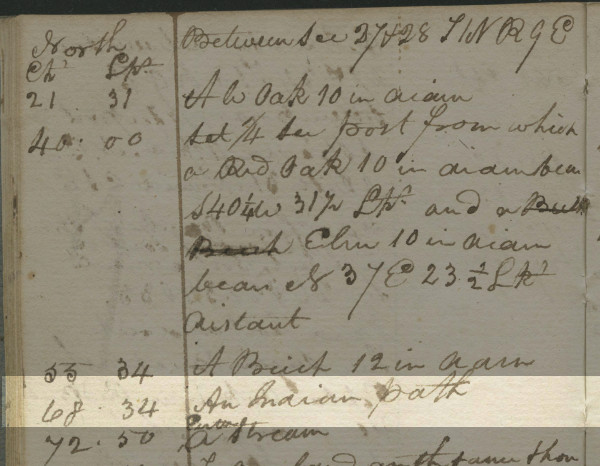

Image courtesy Seeking Michigan. (Source.)

We can see in the highlighted text that at 68 chains, 34 links (4,510.44 feet) north from the Farmington/9 Mile marker, Carpenter noted an Indian path. This is that spot today:
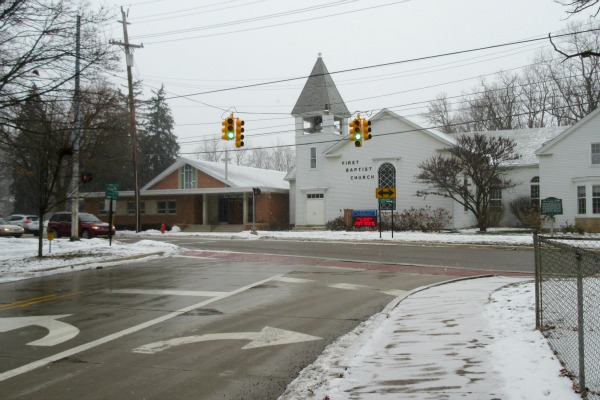
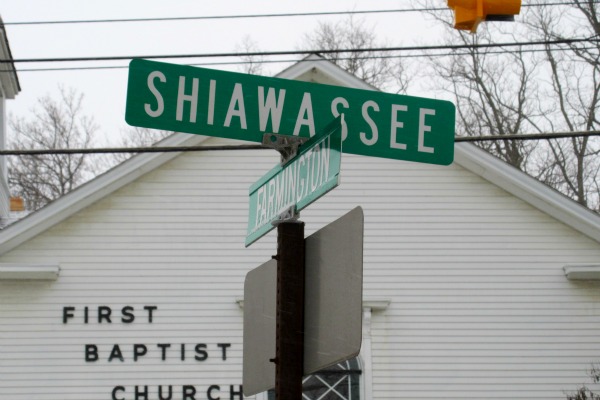


This is Shiawassee Street, once part of the Shiawassee Trail. Google Earth places the point 4,510.44 feet north of Carpenter's survey marker inside of the First Baptist Church, but this road was clearly a continuation of the old trail. Carpenter repeatedly crossed over this trail in his survey, but you don't need to read through his field notes to decode its path. The surveyors themselves drew up plats of the townships they subdivided. Below is Carpenter's plat of this township, years before it contained a single white settler:
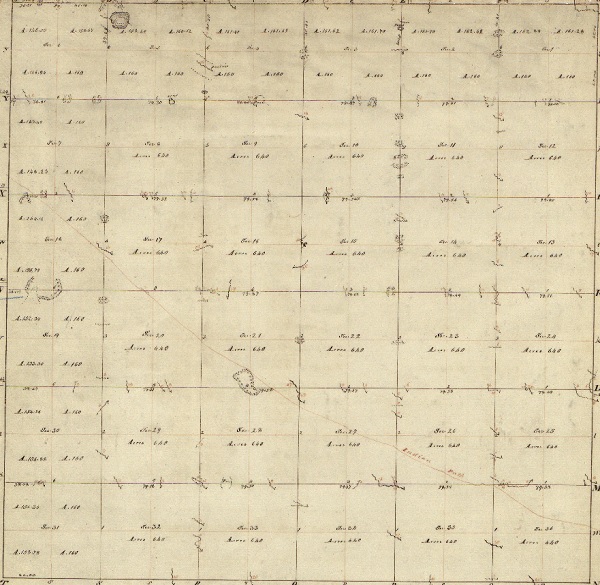

Plat of Township I North, Range IX East of the Meridian, Michigan Territory.
The faint red line running diagonally is a Native American trail.
Image courtesy Bureau of Land Management, General Land Office.
(Source.)

The survey plats often indicated trails with a red line.
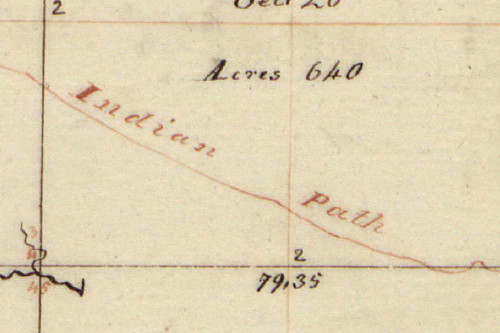

The Shiawassee Trail in Farmington, now Shiawassee Street.

Sometimes the trails were labeled.
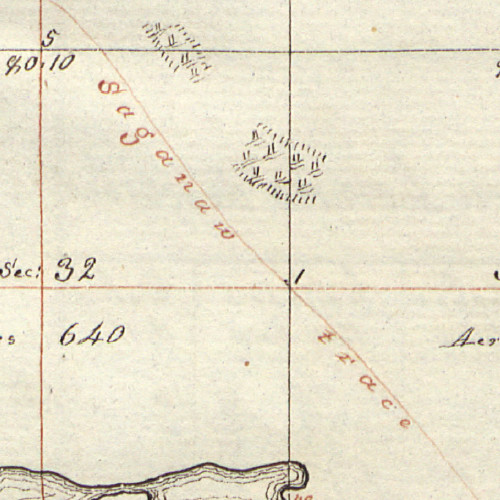

The Saginaw Trail in Independence Township, now Dixie Highway.

Usually paths were only indicated by a dotted line paired with a solid line, and only where they intersected the surveyor's grid.
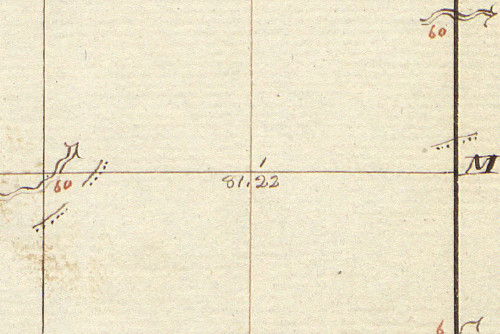

Pieces of the Great Sauk Trail in Canton Township, now Michigan Avenue.

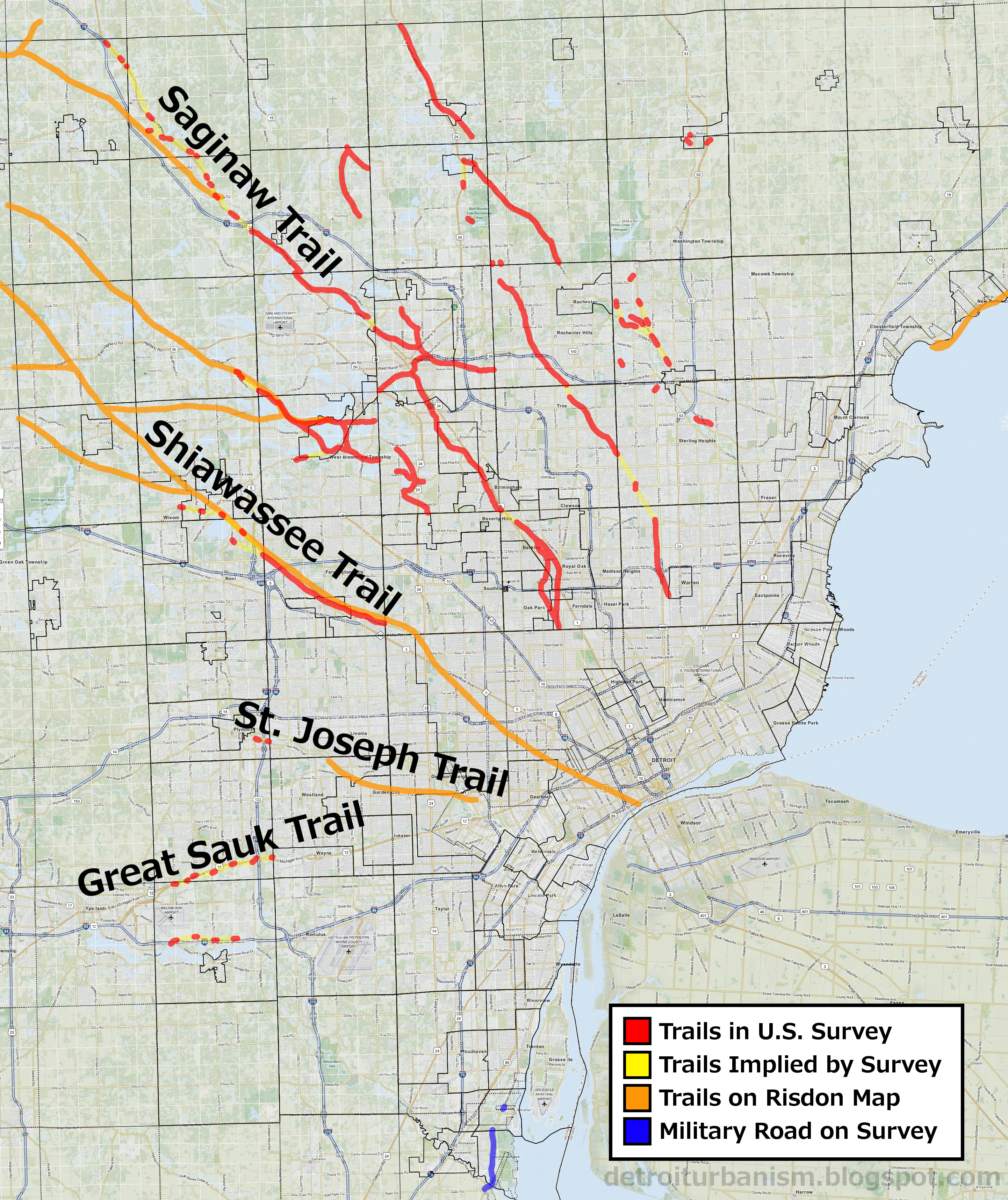
We know exactly where many Native American trails were because their locations were carefully measured in relation to markers that still exist, by eyewitnesses who were trained surveyors, years before any of the land was purchased, developed, or inhabited by white settlers. Because the grid drawn by the surveyors persists--it is what our "mile road" system is based on--it is possible to superimpose the surveyors' plats over a modern map of Metropolitan Detroit and retrace the old trails with great accuracy. Here is a composite of all fifty-eight plats that comprise the tri-county area with trails highlighted in red. Near the bottom is the military road to Urbana, Ohio, denoted in the surveys, highlighted in blue.
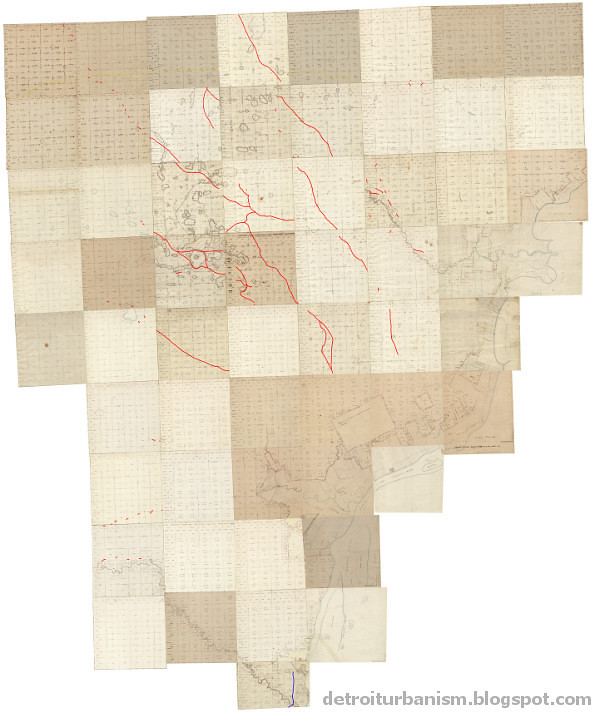

This image isn't quite ready to trace onto a modern map. There are some obvious gaps in the trails. Why are most of Macomb and Wayne Counties devoid of any paths? To find the answer, I looked into who was doing the surveying. All of the townships that comprise the tri-county area were subdivided by five surveyors (and their crews): Samuel Carpenter, Joseph Fletcher, Joseph Francis, William Preston, and Joseph Wampler. Below is a map showing who subdivided which township. Townships that did not indicate any Native American trails on their plats or in their field notes are marked with an "X." Do you notice any patterns?
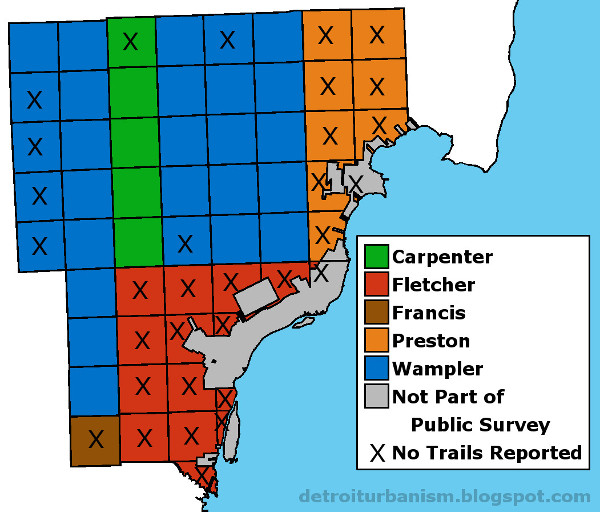

Surveys of Wayne, Oakland and Macomb Counties, 1815-1823.

Isn't it strange that four out of five townships surveyed by Carpenter and Wampler contain trails, while Fletcher, Francis and Preston show a combined total of zero? Maybe these men misunderstood their instructions. Negligence might also have played a role. Fletcher was originally contracted to survey an area close to the Points of Origin for the Michigan Survey, but his work was so flawed that it had to be redone by Wampler. Unfortunately, Fletcher's surveys included all of the modern City of Detroit. We may never accurately know the locations of the Native American trails in the city.


The Orange Risdon Map


In the 1820s, Michigan was on the verge of a massive influx of both homesteaders and speculators seeking cheap land. The southeast part of the territory had been surveyed and was up for sale. Orange Risdon, himself a professional surveyor and well-traveled explorer of the area, tried to capitalize on the mass immigration by producing a detailed map of the region. He utilized government surveys and his own firsthand knowledge to create a map that would help land purchasers make informed selections.
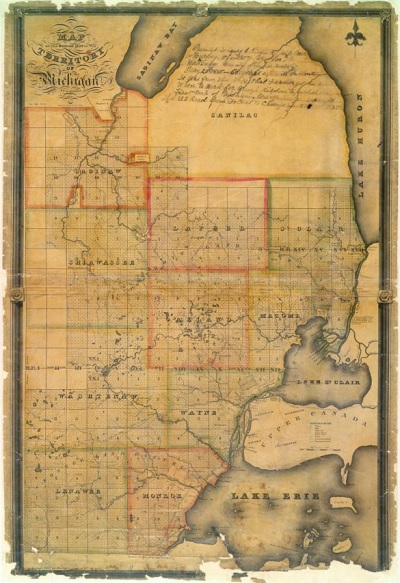

Map of the surveyed part of the territory of Michigan, by Orange Risdon. (Source.)

Risdon published an advertisement in the October 1, 1824 edition of the Detroit Gazette in order to gain early subscribers of the map, which would be published the following year. In the ad, Risdon stated:
"The publisher, having spent some time in exploring that junction of the territory embraced in his map, will be enabled to locate the most important Indian paths, which as they were made by those who were acquainted with every part of the country will be an important guide in the future location of our roads."
Risdon's map uses dotted lines to indicate Native American trails, including the portion of the Shiawassee Trail missing from Fletcher's surveys. Some trails had already been replaced by straight, surveyed roads by the time the map was produced, but enough remained to fill some of the surveyors' omissions.
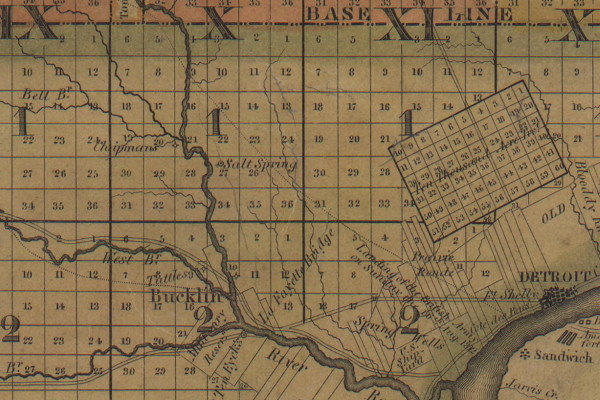

Detail from Map of the surveyed part of the territory of Michigan. (Source.)
Near Bucklin (modern Dearborn) is the St. Joseph Trail.
Leading northwest out of Detroit is the Shiawassee Trail.

Below is an image that superimposes the trails seen on both Risdon's map and the U.S. surveys onto a modern map of Wayne, Oakland and Macomb Counties.
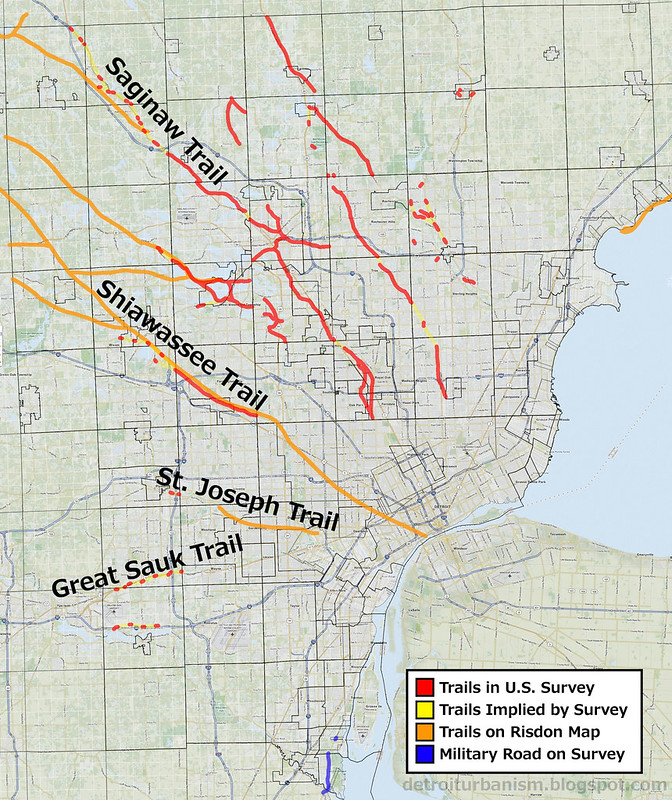

The Native American trails of Metropolitan Detroit.
Click here for a larger version of this map.


Important Trails Around Detroit


The Saginaw Trail • Ran northwest out of Detroit to the Saginaw River. The site of the settlement at Pontiac was chosen because it was where this trail crossed the Clinton River. North of Pontiac, the Saginaw Trail is mostly preserved as the Dixie Highway. But the winding footpath between Detroit and Pontiac was supplanted by the straight and rigid Woodward Avenue in the 1820s. Even this incarnation of Woodward is not quite the same as today's route. There used to be an abrupt jog in the road in Royal Oak to avoid a swamp. The road turned right at what is now Lafayette Avenue, which used to continue to what is now Crooks Road, where it turned left, then continued to Pontiac. I believe that a portion of Lafayette Avenue traces the old Saginaw Trail, which was bypassing the same swamp. Below is an animation showing this road in the 1817 government survey, an 1872 map, and a modern satellite image.


The Great Sauk Trail • Also called the Chicago Road. It ran west from the Rouge River near Detroit, terminated at Rock Island, Illinois on the Mississippi River. In the 1820s, the trail was used as the foundation of a military road to Fort Dearborn at what is now Chicago. This road exists today as US-12.

The St. Joseph Trail • Also called Territorial Road. It connected the Rouge River near Detroit to the St. Joseph River of Lake Michigan, passing through Jackson, Battle Creek and Kalamazoo. The highway that coincided with the trail was originally marked as US-12 before that designation was transferred to the Chicago Road in 1962.

The Shiawassee Trail • Began just west of Detroit according to Risdon's map, ran northwest and connected to the Shiawassee River at the present site of the Village of Byron. It then followed the Shiawassee River downstream to the Saginaw River. The site of Farmington was chosen by its founder Arthur Power because it was where the Shiawassee Trail crossed the Rouge River.

The Moravian Trail • Cleared of timber in the winter of 1785-86 by Delaware (Lenape) Indians who were members of the Moravian Missionary on the Clinton River. The trail ran southwest from the mission along the Clinton River likely where Moravian Road is today. It continued south through what is now Warren, then took a slightly southeasterly course to Connor's Creek on Detroit's east side. The Fort Gratiot Turnpike later replaced the trail as the northeasterly road out of Detroit.

(There are other roads I haven't mentioned which, even though they appear on Hinsdale's map at the beginning of this entry, may not actually be native American in origin. These will be discussed in a future post.)
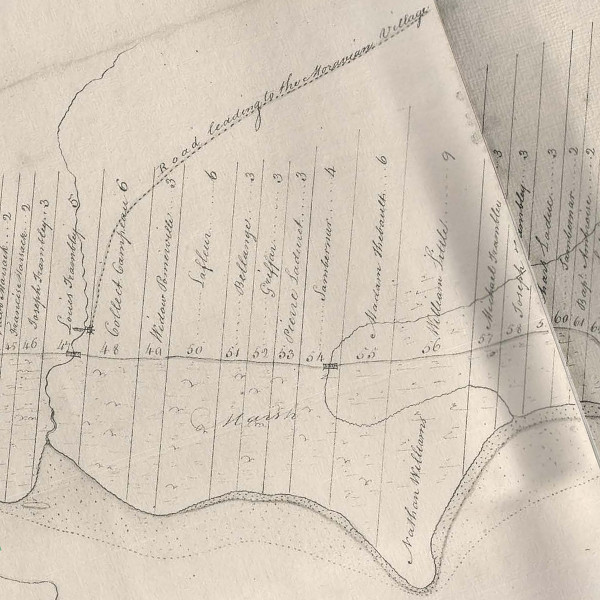

Detail from Patrick McNiff's Plan of the Settlements at Detroit, 1796. The Moravian Trail ended at Conner's (formerly Trombley's) Creek close to the Detroit River.
Image courtesy Detroit Historical Society.
(Source.)
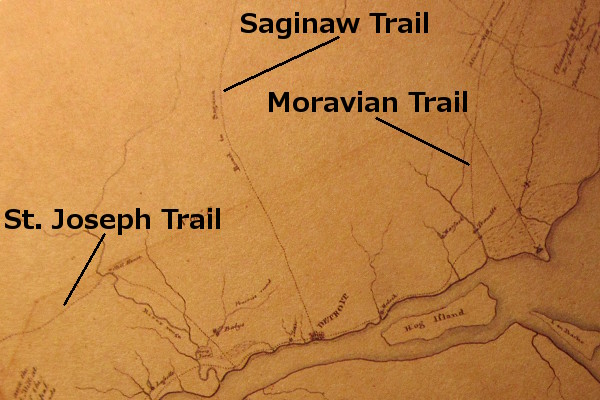

Native American trails near Detroit in 1797.
Detail from
A Rough Sketch of Part of Wayne County Territory by Robert King.
Source: Brian L. Dunnigan,
Frontier Metropolis: Picturing Early Detroit, 1701-1838.

Our map was not a blank canvas when Cadillac landed in 1701. Sometimes we assume that the tribes pushed out of southeast Michigan left without a trace, even as we drive along the pathways they built, unaware of their origin. The land was worked and shaped by those who had preceded us since time immemorial, and the Earth bears witness to this fact.

Monday, January 4, 2016

Other Mounds in Metro Detroit

Although I have yet to discuss "urbanism," I'd like to write a little more about other Native American earthworks once located in Metropolitan Detroit. There were too many to fit into in my last entry, but their stories are an important part of our history.

* * * * *

Hinsdale's Atlas


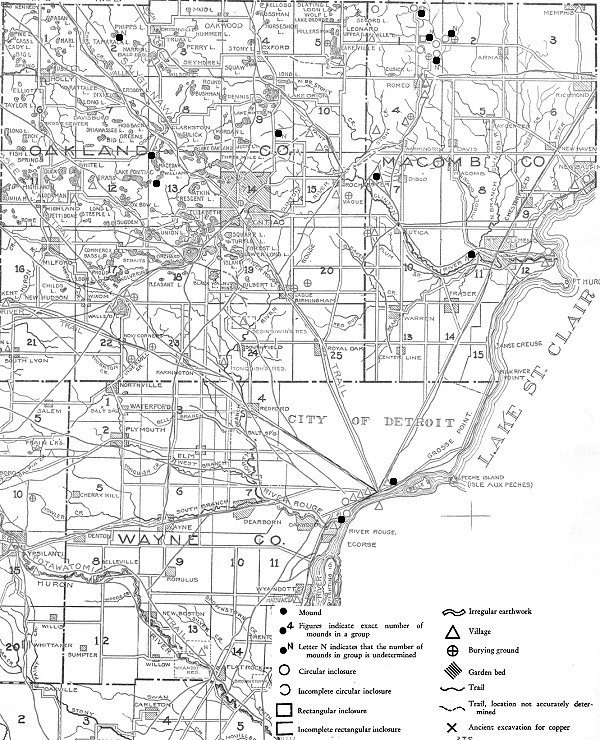
The first attempt to document all known Native American archaeological sites in the state was Wilbert Hinsdale's Archaeological Atlas of the State of Michigan in 1931. Accepted informants ranged from historical documents to "hearsay sources." Hinsdale and his collaborators examined claims and visited sites to determine plausibility, and concluded that there had been more than 1,068 mounds and 113 earthworks in Michigan, but that fewer than 5% "have escaped mutilation." Outside of Detroit, the largest earthworks in the state were found in Grand Rapids and Port Huron.

The following sites in Metropolitan Detroit were included in Hinsdale's atlas:
  • Wayne county--In addition to the Springwells Mound Group covered in my last post, Hinsdale showed a mound by the Detroit River east of downtown. I have not found any information on it.
  • Oakland County--Hinsdale counted five mounds, including "a group in Groveland Township, near the center, and another in the eastern half of Orion Township. The exact number in either group is not a matter of record." A 1960s subdivision in Bloomfield Township contains streets named Indian Mound Road and Indian Mound Trail, but no such features appear near this location on Hinsdale's map.
  • Macomb County--Here there were once twenty-six mounds, eight circular enclosures, and one rectangular enclosure. According to Hinsdale, "All we know of the extensive inclosures [sic] that had been built in unusual designs in Macomb County is gathered from the literature." In other words, they had all been destroyed.


From Archaeological Atlas of Michigan, by Wilbert Hinsdale. (Source.)

Some of the following mounds and earthworks appear in Hinsdale's atlas, others do not.


The Prairie Mound and Mound Road, Detroit


In the mid-19th century, Hamtramck was a large and mostly undeveloped township with borders extending from Woodward Avenue to Connor's Creek, and from the Detroit River to Eight Mile Road. Around 1865, Civil War veteran Philetus W. Norris purchased a large tract of land in the township close to a sandy hill he called the Prairie Mound. An 1876 history of Wayne County described the location:
"The low but fertile glades and blue joint prairies...were alike the chosen hunting grounds of the prehistoric Mound Builders and Indians... The famous Prairie Mound, of some four acres, was ever a chosen haunt for the Indians, trappers and herders; the site of countless broils and revels, and probably the torturing of prisoners--certainly a bone tumulus of the unknown dead."
Norris convinced the Detroit & Bay City Rail Road to come through his property in order to help establish a village there. He wanted to call his settlement "Prairie Mound," but the railroad named their stop "Norris," and the subsequent village plat and post office bore the same name. The original plat contained a Prairie Street and Mound Street, but they have since been renamed Iowa and Davison Streets, respectively. However, the north-south road on the western border of the village was named Mound Avenue. It coincides with today's Mound Road.

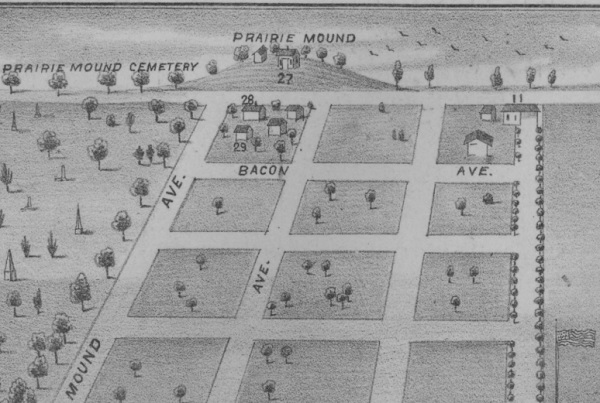
The Prairie Mound would have stood northeast of the intersection of Mound and Seven Mile Roads. It appears on this 1876 "bird's eye view" of Norris:


From Illustrated Historical Atlas of the County of Wayne, Michigan, H. Belden & Co.
Image courtesy University of Michigan.
(Source.)

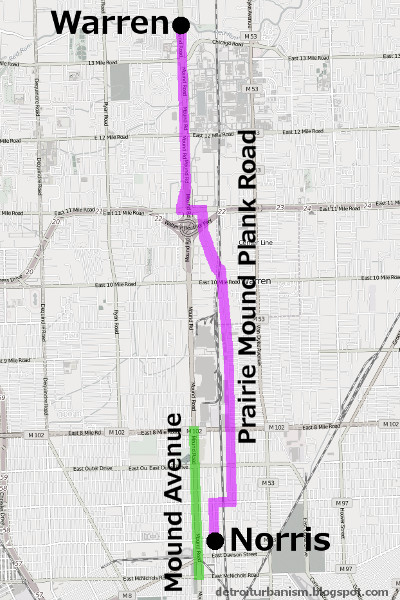
In 1873, Philetus Norris incorporated the Prairie Mound Plank Road Company and was authorized to build this toll road to Warren. To trace the path of the Prairie Mound Plank Road today, begin at the intersection of Nevada St. and Mt. Elliott St. and head north; turn east on 7 Mile Rd., north on Sherwood St., west on 11 Mile Rd., and north on today's Mound Rd. to Chicago Rd., the historic center of the Village of Warren. Today's Mound Road runs from Caniff Ave. in Detroit to Auburn Rd. in Shelby Township, and coincides with the former "Mound Avenue" in Norris and the northern segment of the Prairie Mound Plank Road.


The routes of Mound Ave. and Prairie Mound Plank Rd., circa 1876.

The Prairie Mound was probably not a human-made burial mound. In his 1913 Geological Report on Wayne County, William H. Sherzer wrote:
"The so-called 'Prairie Mound' (in) Hamtramck township, is simply a crescent-shaped sand dune, some 9 to 10 feet high and about 500 feet in length. Upon this William A. Ennis built a house and barn about the year 1865 and came across bones associated with Indian relics,--but whether of the Mound Builder type or not is not known."
Whatever the nature of this mound, there is no trace of it left. Standing at approximately this location today is Lou's Coney Island at 19100 Mound Road, Detroit.


Tucker Farm Earthwork, Harrison Township


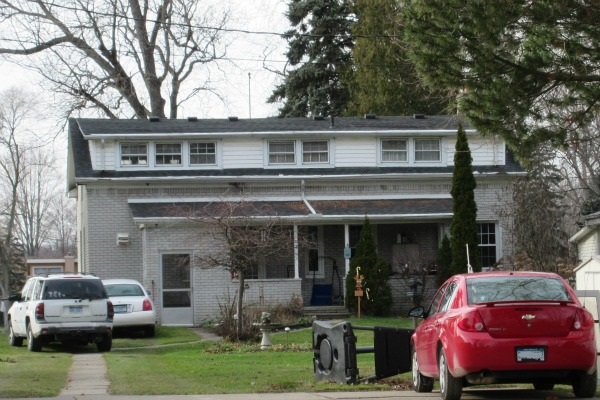
William Tucker was eleven years old in 1753 when a band of Chippewas raided his family's settlement in Stover, Virginia and killed his father. The Chippewas kidnapped Tucker and his brother, adopted them as members of the tribe, and brought them to their homeland in what is now Clinton and Harrison Townships. When Tucker was allowed to leave the tribe at the age of eighteen, he traveled to Detroit and used his knowledge of Native American dialects to work as a guide and interpreter for Detroit merchants, the British government, and Native American tribes. Twenty years later, in 1780, the Chippewas rewarded Tucker for his friendship and honesty in business with a large land grant on the north side of the Clinton River. He built a log cabin on this land in 1784. The home has since been extensively modified, receiving a brick facade in the 20th century. But the log cabin remains hidden beneath, and appears to be the oldest surviving house built in Michigan outside of Mackinac Island.


The William Tucker House, 29020 Riverbank Street, Harrison Township.
This home became a Michigan State Historic Site on February 23, 1981.

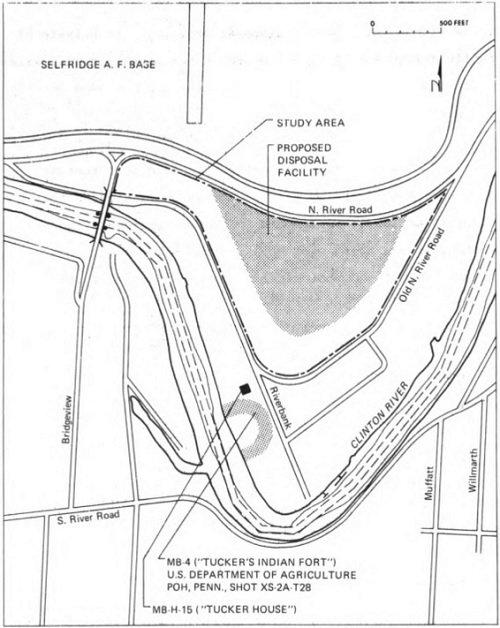
Having been raised by the Chippewa on this land, Tucker knew the area well. The fruitful hunting grounds and the fertile soil made it an ideal place to homestead. In fact, the site Tucker selected had already been an old Native American settlement. He built his cabin next to an old circular earthwork similar to the one found in Springwells. Previous inhabitants of the area had grown maize on the same spot.


The site of Tucker's cabin and the now-lost "fort." (Source.)

Samuel Brown's The Western Gazetteer; Or Emigrant's Directory, published in 1817, noted the existence of the Tucker Farm Earthwork, and Michael A. Leeson's History of Macomb County, Michigan, written in 1882, claimed that there were other such "forts" along the river on land owned by members of the Tucker family. Archaeologist Arnold Pilling, in researching this location (PDF), noted that the earthwork was still visible in an aerial photograph taken in 1940. But by the end of the decade, the entire area had been built over with riverfront cottages.


Northern Macomb County Earthworks


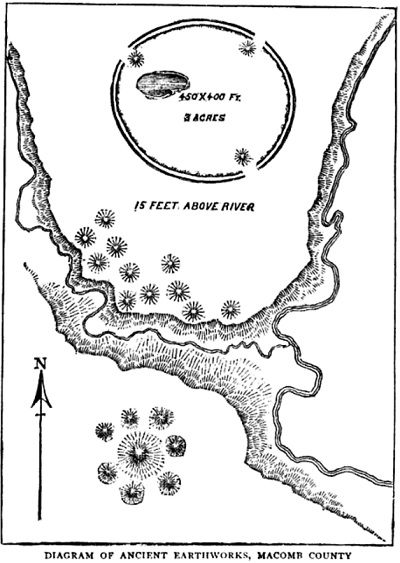
The largest of the circular earthworks of Macomb County was located on a branch of the Clinton River in Armada Township. It encompassed three acres and stood four or five feet high when described around 1830. It was surrounded by a dry moat created by the digging up of the earth for the embankment. A pond lay within the earthwork. According to Leeson's History of Macomb County, south of this "fort" were many small burial mounds, each containing the remains of one individual. On the other side of a nearby stream was a large burial mound, out of which grew a large oak, surrounded by a series of smaller mounds. Not far from this area were found scattered mounds made entirely of stone piled four feet high, each concealing the cremated remains of one individual. All of these earthworks were destroyed prior to 1882.


From Memorials of a Half-Century by Bela Hubbard.

Farther upstream was a smaller circular earthwork with its own set of burial mounds. Edwin P. Sandford of Romeo dug into one of them in 1880 and extracted the skeletons of three adults and three children. Set apart from the smaller mounds was a larger one four and a half feet high with a diameter of twenty feet. A large oak tree grew from this mound which, when cut down, was found to have been 240 years old. When described in 1882, the mound had not yet been greatly disturbed thanks to the massive roots left behind by the felled oak.


New Gnaddenhütten, Clinton Township


In 1781, a group of Christian missionaries from Ohio were arrested and brought to British-controlled Detroit to answer charges of supporting the American Revolution. These were the Moravians, a group of whites and Delaware Indians practicing a form of Protestantism that predated Martin Luther and had been revived by Count Zinzendorf of Moravia several decades before. While some Moravian leaders were in Detroit, the congregants left behind in Ohio were horrifically massacred by American militiamen. Although the Moravians in Detroit were exonerated of the charges of treason, they feared returning to Ohio. With the help of Chippewa Indians and Fort Detroit's commandant, Major Arent DePeyster, they found a new home on the Clinton River, half a mile west of what is today Mount Clemens. They arrived at the site of their future village on July 22, 1782, and named it New Gnaddenhütten.


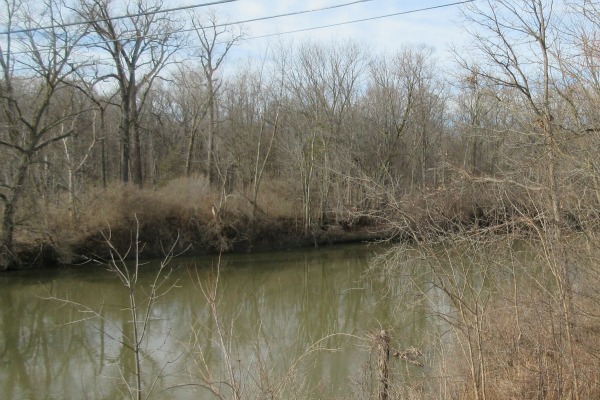
New Gnaddenhütten was founded close to this spot on the Clinton River.

Brown referenced this location in his Western Gazetteer:
On the river Huron [the old name for the Clinton River], thirty miles from Detroit, and about eight miles from lake St. Clair, are a number of small mounds, situated on a dry plain, or bluff near the river. Sixteen baskets full of human bones, of a remarkable size, were discovered in the earth while sinking a cellar on this plain, for the missionary.
Strangely, the diary of David Zeisberger, the Moravians' minister, did not mention any mounds. But he did write that his group "found many traces that a long time ago an Indian town must have stood on this place," including "little hills where corn had been planted, but where now is a dense wood of trees two to six feet in diameter." Perhaps these "little hills" were exaggerated into "mounds" in the twenty years between Zeisberger's landing and Brown's research.


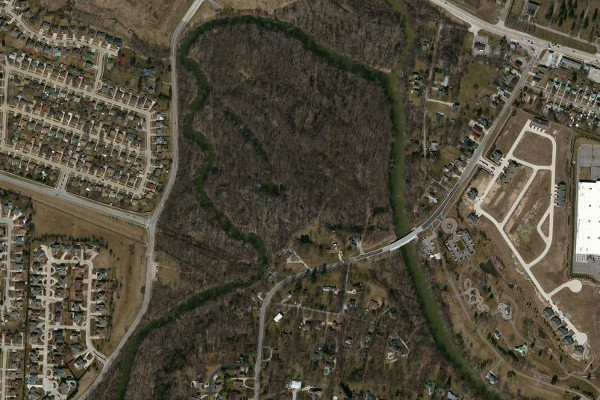
The Moravians' village was near the south bank of this bend in the Clinton River.

Also absent from Zeisberger's diary is an account of unearthing a large number of bones. Archaeologist Arnold Pilling has speculated that the Moravians very well could have encountered a mass burial since it was the site of an ancient village, but no cellar was dug for the mission. Instead, the cellar in question may have been one of the "out cellars" mentioned by the Moravians when describing improvements made to the land several years later (see "Six Archaeological Sites in the Detroit Area," Michigan Archaeologist, vol. 7, Sep. 1961).


Riviere au Vase, Chesterfield Township


Bernard Trinity's Many Yesterdays, published in 1986, recounts the stories told by those who grew up in Macomb County in the early 20th century. A Mrs. Mary Quine recalled attending the Green School, a one-room schoolhouse on Sugarbush Road in Chesterfield Township. "What she remembered especially well about the Green School," wrote Trinity, "was the Indian cemetery that was located on the sandy knoll in back of the school. At noontime school children often gathered on the sandy knoll to play or dig for Indian treasures. Marie frequently joined them." A Mrs. Hazel Stevens recounted the story of Martin Green, who lived across from the school, frequently unearthing skulls in his field and placing them on his fence. After the fence pickets accumulated dozens of skulls, a neighborhood meeting was called to ask Green to remove them. Green stored the bones in his attic, Trinity wrote, but "whatever happened to Mr. Green's collection of skulls and human bones was never explained by the members of Green's family or neighbors." These incidents have been corroborated by other longtime residents of the area, according to Chesterfield historian Alan Naldrett.


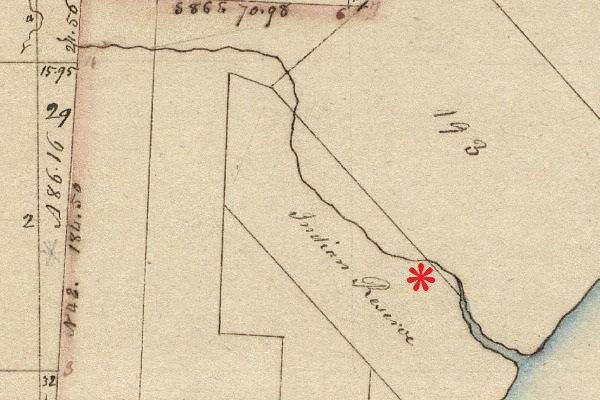
The site of the sandy knoll on an 1818 government survey of Chesterfield Township.
The Chippewa held the land as a reservation per the 1807 Treaty of Detroit.
It and other local reservations were ceded to the U.S. in 1836 when they
were traded for a thirteen square mile reservation west of the Mississippi River.

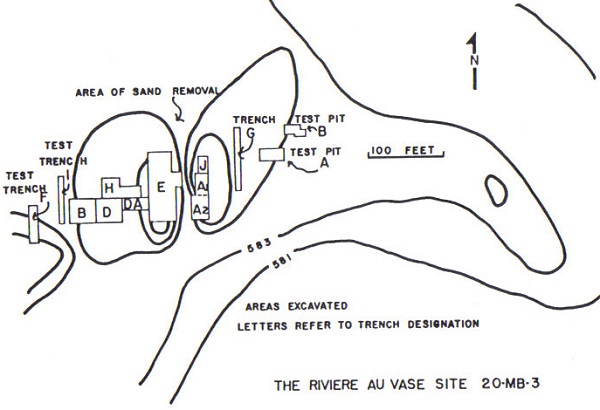
Whether the sand ridge behind the Green School was a natural formation or was partly human-made isn't known, but it had clearly once served as a significant Native American burial ground. Residents reported that part of the sandy knoll was removed for commercial purposes in 1927, upon which more skeletons were uncovered. This sand ridge, located on the south bank of the Riviere au Vase (now called Auvase Creek), was excavated in the summers of 1936 and 1937 by Professors Emerson Greenman and George Quimby of the University of Michigan. Remains from at least 350 individuals were removed. Samples taken from the site have been radiocarbon dated to between 900 and 1200 A.D.


From Late Woodland Cultures of Southeastern Michigan by James E. Fitting.
Image courtesy Alan Naldrett.

In his 1965 report on the 1936-1937 excavations, archaeologist James Fitting decries the poor quality of the record keeping associated with the digs and the subsequent site destruction. "After the University of Michigan excavations," he wrote, "the site was subject to much indiscriminant collecting. Many burials and features were destroyed and artifacts removed with no record of provenience. Only one other excavation was undertaken in a controlled manner and adequately reported. This was done by Mr. Jerry DeVisscher" in 1957.

One and a half miles to the northeast of this location, on the southwest bank of the Salt River, was a circular earthwork enclosure with an entrance facing the river. A white oak tree whose truck had a diameter of three feet grew in the middle of it as of 1837. I have not found any reference to this outside of Leeson's History of Macomb County and Robert F. Eldredge's Past and Present of Macomb County, Michigan.


Undisclosed Location, Southeast Michigan


We drove slowly along the dirt road, trying to spot something, anything through the forest. Even with the summer foliage gone, we couldn't make out any unusual mounds or hills.

But this was the right place. Hidden among the trees was, I believe, a circular earthwork--an "Indian fort"--similar to the one that used to lie in Springwells. The similarity between a 19th century eyewitness description and a shape faintly visible on a 20th century aerial photograph on that very spot couldn't be a coincidence.

Signs were posted nearly every ten feet around the property: "No Trespassing / No Hunting" -- "No Trespassing / Violators Will be Prosecuted" -- and a few weathered scraps of wood with hand-painted lettering: "NO TREZ." Maybe sneaking into the forest was a bad idea. We decided to park the car on the public road and walk up the long, muddy, pothole-filled driveway to speak directly to the property's residents. They will appreciate the direct, honest approach.

A dog chained to the front porch of the careworn house barked when we approached. I waved to a man I saw walking from the house to a pickup truck, but the Unsmiling Man did not wave back. He started his vehicle and drove towards us, and we waited for him rather than approach any farther. The silhouette of a second man appeared in the doorway.

The Unsmiling Man stopped his truck next to me with his window down. "Hi," I said, "I am a ... researcher of history." (Yes, that will do...) "I came across some historical records of an old Indian fort located on this land. The--"

"No." The Unsmiling Man was oddly unphased that someone had just walked up to his house talking about an Indian fort. Then, in a tone that was neither rude nor polite, yet unambiguously demarcated The End of the Conversation, he added, "Stay out of the woods."

The direct, honest approach did not work that day. All that was left to do was turn around and walk back down the long, swampy driveway, with the Unsmiling Man's truck following us all the day down to the road. We did not park near the driveway, but a short walk down the road. As we approached our car, a different pickup truck passed us from behind, turned around where our vehicle was parked, and then drove past us again. Was this the shadowy figure we had seen on the porch, protecting the non-existent Indian fort that isn't in the woods that we definitely shouldn't go into?

Although I was disappointed to have missed out on the chance to commune with the past amid the ruins of a lost civilization, let's face it--these events are essentially confirmation that prehistoric earthworks are very much intact right here in Metropolitan Detroit. And I am happy to see that they are hard to find, well hidden, and well protected.

Wait, should I just have bribed him instead?